Sleep problems and anxiety among Chinese people are often more severe than we imagine. Moreover, an increasing number of people are treating sleep as a key performance indicator, tracking what time they fall asleep, how many hours they sleep, and even using smartwatches to score their sleep quality.
The more one thinks, the more anxious they become, and the more anxious they are, the harder it is to fall asleep. This anxiety has quickly turned into a business opportunity, with various major textile brands launching their own sleep-related products. However, the one that has made the biggest splash is actually a hotel.
Atour operates its own mid-range hotels while continuously producing various sleep-related products, particularly pillows, as if determined to bring the hotel experience into your own bed. On August 20, Atour released its Q2 2026 earnings report, with retail business (Atour Planet and other home textiles) generating 15.75 billion yuan in revenue and franchise hotel business generating 17.25 billion yuan. The gap between the two has narrowed to less than 2 billion yuan.
Atour: Where It Stands Now
On August 20, Atour released its Q2 2026 report, with total revenue reaching 3.49 billion yuan, up 41.4% year-over-year, and net profit attributable to the parent company at 548 million yuan. The numbers look promising, and the management has raised its full-year revenue guidance, expecting a 30% year-over-year increase. However, the revenue structure of its internal business segments has undergone significant changes.
On the hotel side, Yadu remains the most familiar to the public, with 2,175 hotels in operation as of the end of the second quarter, and 811 reserve projects, of which more than 99% are franchise or managed franchise models. Yadu Group provides branding, standards, and membership systems, while franchisees invest in and renovate projects.
This hotel franchise expansion model has been in play for nearly a hundred years, and its most outstanding advantage is its astonishing efficiency: in 2025, it achieved a net increase of 403 stores, with the entire listed company's annual capital expenditure totaling only 86 million yuan. To put it into perspective, according to calculations by Guosheng Securities, the cost of building a standard Atour room is approximately 140,000 yuan, and for a store with an average of 113 rooms, the cost of the rooms alone would exceed 15 million yuan, almost all of which needs to be borne by the franchisee themselves.
With the scale reaching the level of 2000 outlets, the growth momentum is bound to experience diminishing marginal returns, especially for franchisees, as the hotel business is notoriously unprofitable.
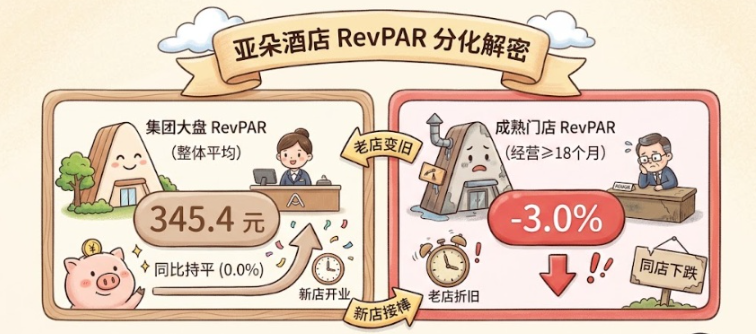
The group's overall RevPAR, or average revenue per available room, was 345.4 yuan, which was roughly flat compared to the same period last year. However, for mature stores that have been in operation for over 18 months, same-store RevPAR actually declined by 3.0%. As older stores become less competitive, new growth drivers will need to come from elsewhere.
The scenery is elsewhere, and the "elsewhere" that Yadu has found is the pillow.
Atour Planet: Pillows and Blankets Grow Wild
The story of Yado Star is essentially one of successful supply chain expansion, still a light-asset game. At its core, this is similar in logic to Yado's approach to running hotels.
Atto doesn't own the vast majority of its hotel properties, with 2,156 hotels operating under a management and franchise model as of the end of June this year. Atto doesn't need to purchase, renovate and own all the hotels itself, instead providing franchisees with its brand, product standards, management systems and supply chain capabilities.
Franchisees are responsible for actually building the hotels, while Yado is responsible for telling franchisees what a Yado should look like.
Selling pillows is no different, what makes this business easy to operate is the client logic, where Yadu does not produce pillows itself, but instead commissions contract manufacturers to produce them. The factories are responsible for the machines, production lines, warehouses, and digesting inventory, which are all heavy assets, while Yadu is responsible for designing specifications, quality standards, and brand premiums. The brand side always only handles the lightest part and passes the heaviest burden to others. Franchisees build houses, contract manufacturers produce pillows, and Yadu collects money in the middle.
Atour has a hotel network that is hard for traditional home textiles brands to replicate - after all, how good a pillow is, and whether it fits the physiological curvature of the human body, cannot be determined by a single picture.
However, hotels provide a natural scenario for experiencing products, where consumers stay to meet their basic accommodation needs, and in the process, naturally use Yadu's pillows, mattresses, blankets, and other products.
Each stay is a product trial.
With 2,175 hotels and over 240,000 rooms, Yado has to some extent established a vast offline experience network. Traditional home textiles brands need to constantly incur customer acquisition costs, such as promoting products on the ground or opening physical experience stores, to get consumers to walk into their stores. For Yado, the experience is almost a byproduct of staying at the hotel.
Staying in a hotel, experiencing products, recognizing the experience, making online purchases, and repurchasing - Atour's hotels are responsible for creating the experience, while Atour Universe is responsible for converting the experience into reproducible goods.
In recent years, Yadu has finally found one of its most effective bestsellers - pillows, with cumulative sales of the Yadu Deep Sleep Memory Foam Pillow Pro series exceeding 12 million units as of the second quarter of this year. Yadu Planet is also transitioning from a single bestseller to a more comprehensive product portfolio, with chip-related products growing rapidly, and new product categories such as cooling bed canopies, gravity eye masks, and home wear also starting to increase their revenue contributions.
What truly sets Ya Du apart is not just taking a single pillow product from hotel linens and selling it, but rather finding a new business logic: hotels provide the experience, while retail amplifies the scale. Relatively speaking, the number of hotel rooms is always limited, with a predictable ceiling, but the sales of consumable products like pillows have no physical limit.
As the retail business approaches that of the hotel business, a new issue arises: is Atour's hotel network serving the hotel business or increasingly serving the retail business?
Will Franchisees Become Pure Offline Experience Stores?
The game looks spectacular on the surface—but at whose expense is it being played?
The more successful Atour's retail business becomes, the more complex and confusing the role of its hotel network grows. For Atour Group, hotels are certainly not just a source of accommodation revenue—they also serve as the most direct space for brand display, a gateway for membership acquisition, and a scenario for consumer experience.
As Yado Planet continues to expand, its hotels have taken on a new function: offline experience stores.
The issue is that the vast majority of Yadu hotels are not directly invested by the company itself, but rather by a large number of franchisees who bear the actual risks of property, decoration, labor, and daily operations. However, the Yadu Group can still directly benefit from the growth of the entire retail business.
For franchisees, their core objective remains operating the hotel.
Atour and its franchisees share aligned interests in most cases. A superior product experience boosts guest satisfaction, which in turn drives repeat visits and elevates the brand value of the hotel.
However, as hotels (especially franchisees) increasingly take on retail product experience functions, potential benefits misalignment has also begun to emerge.
A guest who tried Atour's pillow during a one-night stay at a franchisee-invested hotel returns home and purchases it the next day on an e-commerce platform. Who pockets that retail revenue? Atour Group, of course.
What franchisees gain may only be an indirect improvement to the guest experience. If retail products are simply one component of the hotel experience, then this relationship is naturally unproblematic.
But if the retail business gradually becomes one of the group's largest revenue segments, the hotels invested in by franchisees will undergo a more subtle shift in identity. They transform completely from hotels into product experience venues for Atour Planet—or, one might say, offline experience stores built at the franchisees' own expense.
The spillover gains generated by the retail business, however, went entirely to no one—least of all the franchisees with the greatest potential to contribute.
For a consumer goods company, this kind of channel efficiency and ROI is extremely high. But for franchisees, investing tens of millions of yuan to build a hotel, bearing the property and operational risks, are they, beyond running the hotel itself, simply working for the benefit of the group headquarters that collects franchise fees?
From Viral Products to a Real Consumer Brand?
Compared to the concerns of its franchisees, a more immediate problem is that the home textiles business has a shallower moat.
Huazhu has launched its own M1 and M3 memory pillows, and is engaging in a price war, with prices noticeably lower than those of Yado. The M1 is priced at 269 yuan, while the 12cm version of the M3 Plus is 369 yuan. In comparison, Yado's latest Deep Sleep Pillow Pro4 is priced in the 450 yuan range.
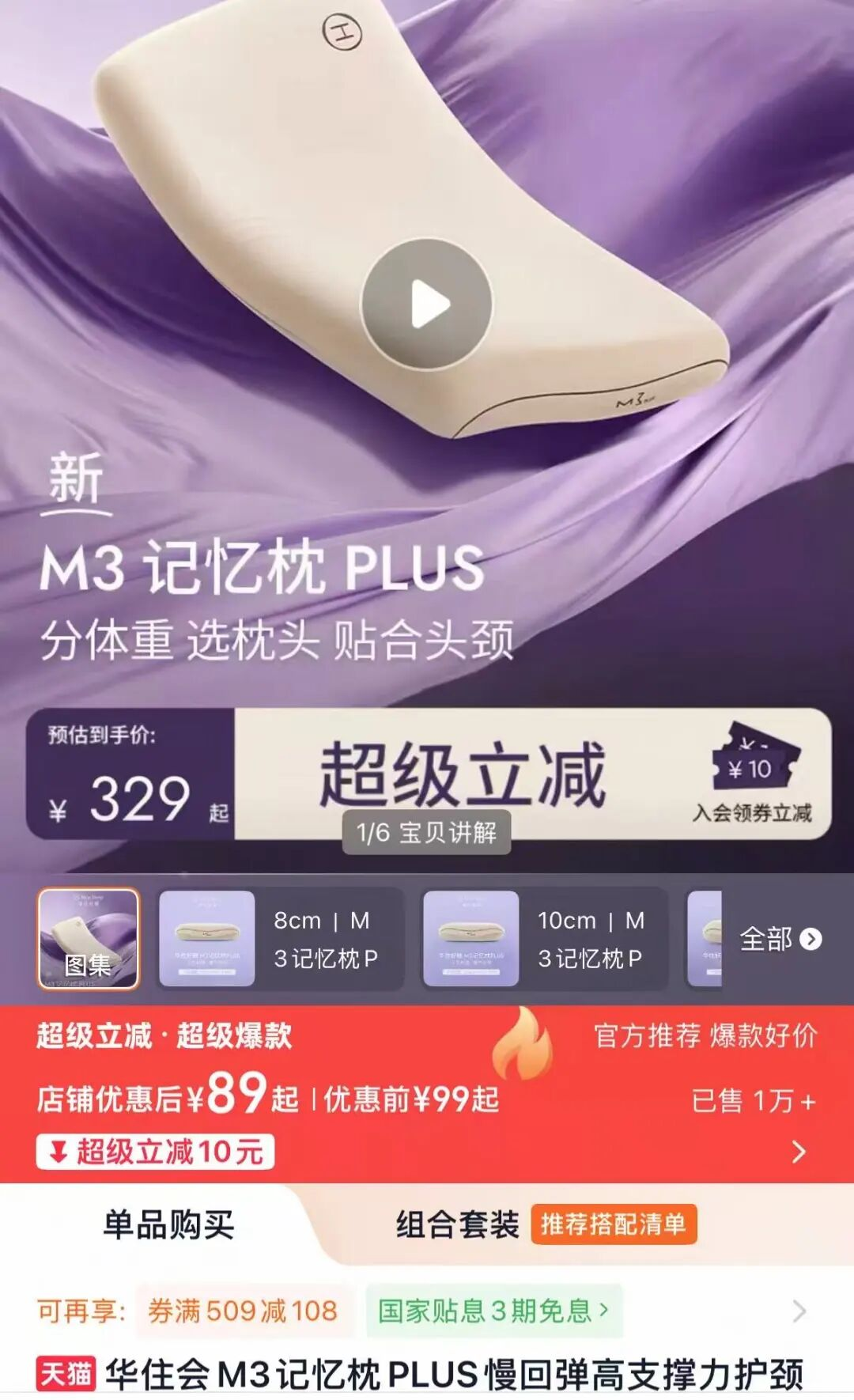
Huazhu's self-operated hotel same-model memory pillows
The technical barriers in the bedding industry were never particularly high to begin with. Once a product goes viral, factories in Jiangsu and Zhejiang can produce a sample within two days and start mass production within a week. Atour rarely discounts and doesn't chase short-term trends, insisting on product innovation driven by genuine sleep needs. That's all well and good, but competitors don't need to innovate at all—they can simply copy a passing-grade answer and undercut on price, which is more than enough to turn the lower-tier market upside down.
The premiumization push at the hotel end is still just the opening chapter. Atour's Jianye brand posted RevPAR above 450 yuan in Q2, while Sahe surged past 1,000 yuan—yet Jianye has over 60 properties in operation and Sahe only three. The high-end segment's share of the portfolio is so small as to be nearly negligible; the real foundation remains those mature, older hotels with year-over-year RevPAR declines.
Atour still has a large pipeline of hotel projects in reserve, and its hotel network remains the company's most important revenue driver. Without a vast network of properties, Atour would lose its most distinctive offline experience scenario. The hotel business and retail business are not substitutes for one another; rather, they are likely to form a new relationship in which hotels provide brand and experience, retail expands the user base and revenue, and the membership system connects both sides to reinforce each other.
The truly ideal scenario in the future is that consumers might check into an Atour hotel for a business trip, or they might walk into an Atour hotel for the first time because they bought an Atour pillow.
Previously, the value of a hotel came mainly from a single night's room rate. Now, within Atour's ecosystem, a single stay can also lead to a product experience, an online order, and even longer-term lifestyle spending.
But the real challenge is getting hotels, franchisees, and retail operations to all sleep soundly at night.