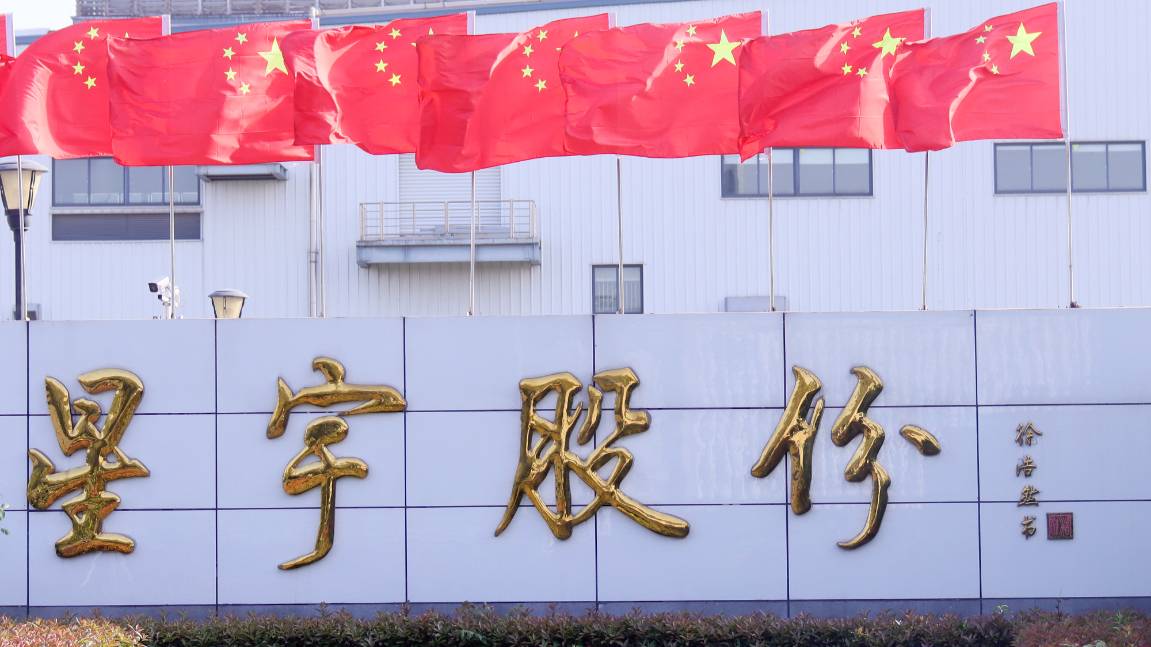
This topic has been widely discussed online, and I didn't want to write about it initially, but Zhou Xiaoping, the owner of Changzhou Xingyu Shares, personally came forward to say: "We have also filed complaints and reports with the internet information and internet security departments regarding the false reports by some media outlets." Since a billionaire owner is so confident, I have no choice but to write about it again.
Firstly, if there were indeed "false reports", that would be incorrect, and if Xingyu Shares were negatively impacted by such false reports, they could naturally report or complain, and apply to have the posts deleted or accounts banned. However, the author has yet to see any news reports from licensed major media outlets being deleted. Meanwhile, Xingyu Shares has also stated to the capital market that after the outbreak of negative public opinion, orders were not significantly affected. It seems that these "false reports" have virtually no impact on Xingyu. Following Xingyu's logic, if false reports are unlikely to have an impact, then wouldn't factual reports be even less likely to have an impact?
Domestically, the current economic environment has resulted in a grim employment situation for new graduates, with enormous pressure to ensure employment. This is also one of the most important tasks, from the central government to local governments, with the State Council having released the "Implementation Plan for an Employment-First Strategy during the 14th Five-Year Plan" just in June.
Xingyu Shares is not in a sunset industry and has not experienced an industry downturn. The company itself is preparing for an "A+H" listing, and its profitability is not a problem. Although the automotive industry is undergoing global structural adjustments, it is still booming overall. As the leader in the automotive lighting segment, being based in mainland China, holding long-term orders from overseas automotive giants, and meeting the expanding demands of domestic automotive companies, the company is in a strong position.
According to the IPO application materials of Xingyu Shares, based on 2025 sales revenue, the company ranks first in China's automotive lighting market and seventh globally; in the intelligent car lamp market, it ranks first both globally and in China.
However, such companies have not only failed to become benchmarks for job security, but have also led to serious labor disputes, and instead of being models for high-quality development, they have become typical examples of exploiting new graduates.
According to Xingyu Co., Ltd.'s disclosure documents, its workforce fell from 10,426 employees at the end of 2024 to 7,532 at the end of 2025, with production staff down 3,182. Meanwhile, outsourced labor hours rose from 8.648 million to 10.874 million.
At the same time as outsourcing replacements, Xingyu Shares is targeting not low-skilled, low-educated employees, but rather newly graduated master's degree holders. Although graduates of different educational backgrounds have equal rights under labor law, the resources and effort invested in cultivating a master's degree holder are obviously far greater than those for people with lower educational backgrounds, whether from the perspective of the country, family, or individual.
Although the current employment situation is severe, master's graduates still have some advantages. Xingyu Shares recruited and then let go of over a hundred freshly graduated master's students in a "hire and fire" manner, disregarding the importance of their new graduate status in job hunting, resulting in a huge cost for these families and individuals. This cost is obviously not just about losing a job or adding an unfavorable experience to their resume, but also about the loss of opportunity costs that they should have had as new graduates, which is difficult to quantify. Simply expecting compensation for a few months' wages and thinking that's the end of it, with the company not having to take any other responsibility, and while public opinion is still at its peak, the company's leaders even threatened to complain to and report the media, clearly showing that they still don't understand the severity of the situation.
Internationally, as the mainland China's trade surplus continues to expand, the external economic and trade environment is becoming increasingly complex and severe. The questioning of mainland China's labor employment issues is the current focus of developed countries such as Europe, the US, and Japan. If mainland China's tech or other relatively well-developed companies, like Xingyu Shares, treat their employees in a similar manner, then the ones truly "handing over the knife" to overseas companies are not the students who complain and report to overseas companies, but rather companies like Xingyu Shares themselves. The more such companies there are, the more difficult it will be for mainland China to conduct external trade negotiations.
In other words, the adverse impact of the Xingyu Shares incident has already exceeded Changzhou and even Jiangsu Province. If such behavior does not incur sufficient costs, more companies will follow suit in the future.
In recent days, some media outlets and journalists have been trying to downplay the situation, either by emphasizing the need to "comply with overseas regulatory requirements" or by calling on Xingyu Shares to accept the 107 graduates whose contracts were terminated. Although this appears to be an attempt to ease tensions, it is actually adding fuel to the fire.
The controversy is not about these 107 graduates, but about the millions of university graduates who graduate every year. They can understand that the job market is tough, but they cannot understand why leading companies like this can openly engage in such practices. If trust between enterprises and laborers completely disappears, what consequences will arise?
Did Xingyu Shares actually break the law? The Constantine Human Resources and Social Security Department is expected to provide a clear conclusion after conducting an in-depth investigation. If no laws were broken, then the problem lies with the legislation; if laws were broken, then severe punishment should be imposed to deter other companies from doing the same.