
In just a few days, it will be the one-year anniversary of the "pre-made dish war" between Luo Yonghao and Jia Guolong.
After the turmoil in 2025, Jia Guolong has been relatively quiet, but he has not been idle. In February this year, he opened a flagship store featuring Inner Mongolia's Baotou specialty "Tianbian Sand Pot Noodles" in Beijing's 798 Art District. On August 7, the day of the beginning of autumn, the new sub-brand "Tianbian Yang Duo" opened its first national store at Beijing's Wanda Plaza in Fengtai District.
Tian Bian Yang Duo is positioned as a fresh mutton cuisine brand, with a focus on grilled mutton skewers and hand-pulled mutton, and its average customer spend on Dianping is currently concentrated in the 80-100 yuan range.
In just half a year, a new series was launched, and two sub-brands were opened, Ji Guolong seems not to have slowed down as he said in an interview at the beginning of the year.
What's even more intriguing is that the first store of Tian Bian Yang Duo was directly opened at the original location of Tian Bian Dun Mian, which was previously a Xi Bei Men Dian store. Why has the same location changed its facade twice in just half a year?
From selling braised noodles to selling mutton
In January, Jia Guolong confirmed that Xi Bei would close 102 stores, accounting for about 30% of its total stores at the time. In a related interview, he revealed his hope that a new brand could take over some of the stores and employees. Shortly after, "Tian Bian Sand Pot Noodles" officially debuted in February, and the "Tian Bian" series was born.
The brand's flagship product is Inner Mongolia's Baotou-style braised noodles, with an average customer transaction price of 40 to 50 yuan. According to data from Zhuanmen Canyan, as of September 1, the brand has opened 32 stores in 10 provinces and 14 cities across the country, with an expansion speed that cannot be said to be slow.
The recently launched "Tian Bian Yang Duo" is the second brand under the series. Notably, the Tian Bian Yang Duo store in Beijing's Fengke Wanda Plaza previously operated as Tian Bian Sha Guo Mian, marking a second iteration of the same storefront.
The same store changed its identity twice in just half a year, making people wonder: did the braised noodle business also encounter problems? If business was good, why did the original braised noodle store have to start over from scratch?
A person in charge of Tianbian Sandpot Noodles stated to the China Business News that the operation of the noodles business is stable and not struggling to continue.
However, based on user feedback from the internet, external assessments are not optimistic.
Some netizens have stated that the braised noodle category is not suitable for large-scale expansion, as roadside eateries often offer braised noodles for 10 yuan per serving, with 20 yuan being the high end. In comparison, while Tianbian Sandpot Braised Noodles has a lower average price per customer than Xibei, its pricing of 40 to 50 yuan is still relatively expensive in the braised noodle market, with no obvious price-performance advantage.
On a Saturday evening at 7:30, the author visited the Tianbian Sand Pot Noodle Shop in Hangzhou.
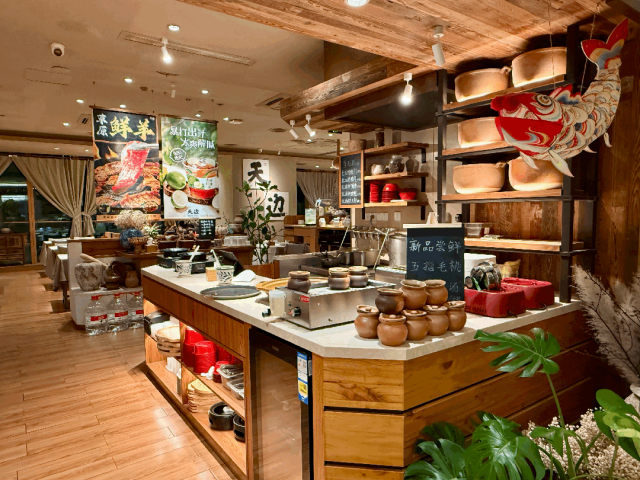
Tianbian Sand Pot Noodles at the Hangzhou Huanglong Wanda Store (Photography: Li Xinyu)
The store is located on the fifth floor of the K-lab mall in the Huanglong International Center. During the summer weekend dinner hours, the first and second floors of the mall were crowded with customers, but inside the store, there were only a few scattered tables of guests, and even after about an hour when the meal was ending, no new customers were seen.
From the surrounding businesses, the area is mostly filled with small noodle shops, with per capita spending of 33 yuan at He Fu La Mian, 28 yuan at Jiang Xiao Jian Suan Mian, and 33 yuan at Li Wen Dong · Fresh Noodle, all of which have low occupancy rates during this time period. Meanwhile, on the other side of the fifth floor, full-service restaurants like Green Tea, Waipojia, and Hu Li Ai Shang Yezi Ji are nearly full.
In the author's experience, the biggest problem with Tianbian Sandao Braised Noodles is that its positioning is somewhat awkward. With an average per-person price of 40-50 yuan, it is obviously on the higher side in the rice and noodle fast food sector, but its label is that of a noodle dish, which does not quite meet consumers' expectations for a full meal.
Actively Saving Themselves, or Back to Old Ways?
It has to be said that Jia Guolong really loves to take on challenges.
Starting from 2015, he has been devoted to incubating new projects for nearly ten years.
According to a report by LatePost, these projects spent a total of 1 billion yuan, but every single one of them failed.
At that time, Jia Guolong had the confidence to make his move, as the success of the main Xibei brand brought him a steady stream of cash flow. For nearly 10 consecutive years, Xibei's sales remained above 5 billion yuan, and in 2023, it even exceeded 6 billion yuan.
After the 2024 Chinese New Year, business began to decline, according to Jia Guolong. Therefore, at the beginning of 2025, he finally refocused and returned to his post as CEO of the main brand, planning to concentrate on the core business "Xibei Youmiancun".
However, soon after its return, Xi Bei was embroiled in a pre-made dish controversy.
This incident has dealt a severe blow to Xi Bei. Data shows that from September 2025 to March 2026, Xi Bei accumulated losses of over 600 million yuan. Additionally, there is also intangible damage to its reputation.
In order to save himself, Jia Guolong had to open another "small account". This time, he seemed to have really changed.
Looking back at his past projects, such as Jia Guolong Gongfu Cuisine, Jia Guolong Small Pot Beef, and Jia Guolong Chinese Burgers, which all had his name prominently displayed, it's clear that his personal touch was quite strong. However, after a series of controversies, the subsequently launched "Tianbian" series has been relatively low-key, with its name no longer directly associated with "Xibei" or "Jia Guolong", and its store decorations also barely featuring any Xibei elements.
Furthermore, the operation model has also changed, with the "Tian Bian" series being independently operated.
It is reported that "Tian Bian Yang Duo" is fully responsible by an internal team at Xi Bei with an average age of post-95s, and Jia Guolong only determined the general direction of "creating a new brand for fresh lamb" during the project initiation phase, while subsequent decisions on menu structure, tableware selection, store design, and other implementation details were made by the team.
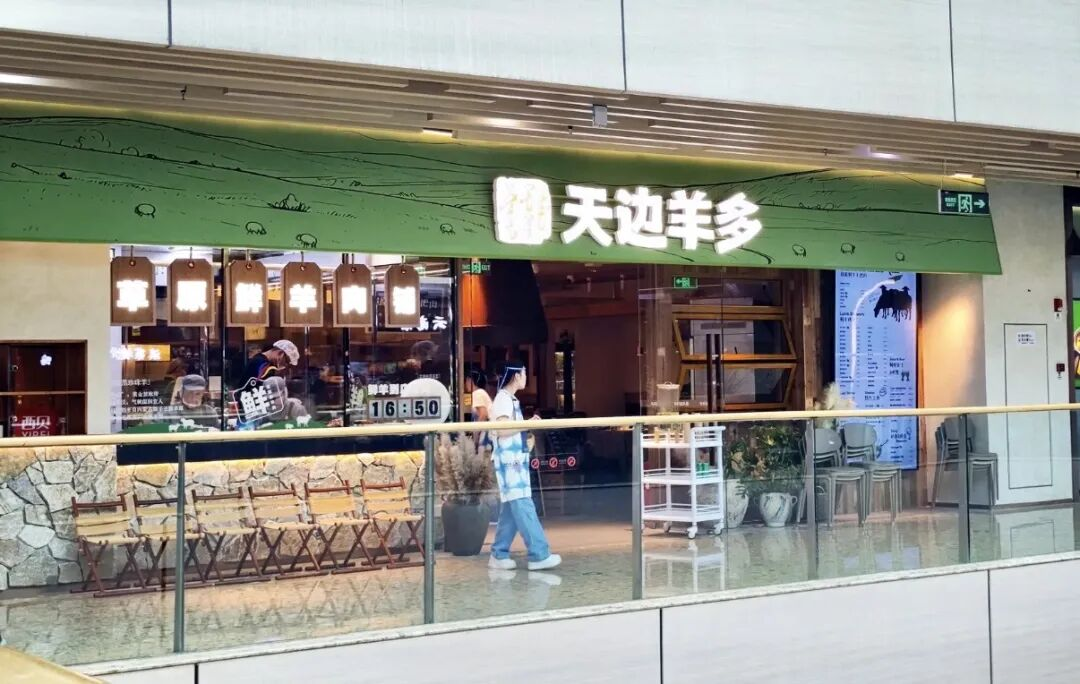
Tianbian Yangduo's first Beijing store. (Image source: Dianping @ You Niao)
Yet the pace of the Tianbian series rollout feels oddly familiar — Jia Guolong has historically incubated new projects at a rate of roughly one per year.
Tian Bian Dun Mian, which just opened in February, has already expanded to 29 stores, covering 14 cities in a rapid pace. Recently, the Tian Bian Dun Mian store at Beijing's Fengke Wanda Plaza was replaced with the first store of Tian Bian Yang Duo, an operation that reminds people of what happened in the winter of 2023, when over 50 Jia Guo Long Chinese Burgers stores in Beijing were suddenly rebranded as Xiao Guo Niu Rou.
According to a LatePost report, some Xi Bei store managers have followed Jia Guolong through six projects, with a few instances where they felt the stores were already "doing well", only to be abandoned due to Jia's rapid pace of launching and dropping projects, resulting in few successes. In an interview with the media at the beginning of the year, Jia Guolong also rarely reflected, "(I) have a big appetite and try to do too much, my energy is not focused."
In just under half a year, Jia Guolong has launched two new brands, but is this a well-considered strategic adjustment or a return to old habits?
Another small account
According to the Daily Economic News, Huixiangyuan, a brand that prides itself on "good meat doesn't need marinating, just sprinkle some salt," saw a surge in popularity on its opening day, with all seats filled within 20 minutes of opening and the first batch of braised pork hands selling out in under three hours.
But trying new things is in the nature of consumers. For Tianbian Yangduo, the initial excitement does not necessarily translate to sustained profitability.
First, there are limitations related to the ingredients themselves. According to the person in charge of Tianbian Yangduo, all the fresh mutton in the stores comes from Sizi Wang Banner in Inner Mongolia, and is delivered to the stores at 4:30 am every day, and is sold on the same day without being stored overnight.
This means that fresh mutton must be sold out on the same day it arrives at the store, otherwise it will result in ingredient losses, which puts the store's ability to predict customer traffic to the test.
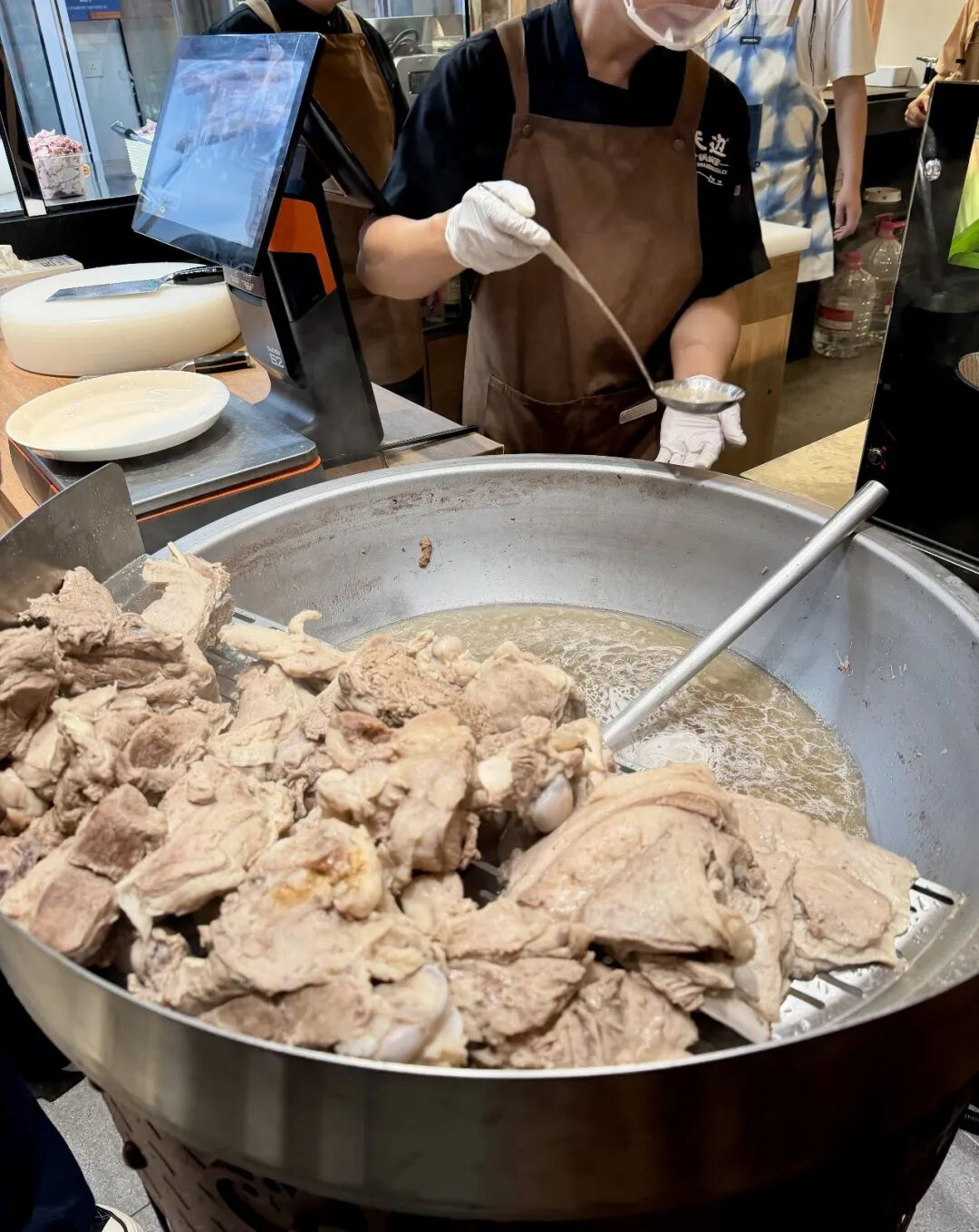
Tianbian Yang uses the Fresh Sheep model. (Image source: Xiaohongshu @dalanzi)
Secondly, the Xi Bei model is far more dependent on the supply chain than ordinary restaurants. Xi Bei also acknowledges that the cost of its cold chain logistics for fresh lamb "increases as you go south, and will need to be a key area of optimization for future expansion".
Furthermore, the pricing of Tianbian Yangduo is also in question. Currently, there are several mediocre reviews on Dianping, with most complaints centered around the word "expensive". The hand-pulled mutton is priced by weight, equivalent to 150 to 180 yuan per kilogram; the lamb skewers start at 8 yuan, but some consumers have found that they contain 10 grams less meat than those from Xibei Old Store, yet are more expensive.
In addition, Tianbian Yangduo's roast district has adopted the popular show kitchen model, which can indeed strengthen the trust in "visible freshness", but also raises higher requirements for hygiene and quality control, as well as the chef's performance skills, affability, and communication skills. This undoubtedly increases the difficulty of subsequent chain store expansion.
Jia Guolong's internet celebrity status has made his every move closely watched.
As of now, Tian Bian Yang Du has been open for less than a month, and on Xiaohongshu, someone posted that the dishes are not bad, but this was immediately followed by a wave of doubts.
The same is true of Tianbian Sandpot Noodles. Some people say the serving size is too large for two people to finish, while others claim it's not filling enough. It's clear that on such a basic issue, consumer reviews are highly polarized, with some consumers bringing their personal feelings about Jia Guolong into their product evaluations.
For well-known food and beverage brands, the public image of their founders is an important part of their brand narrative. The "Tian Bian" series has downplayed the role of its founder, but Ji Guo Long's past statements, controversies, and business ambitions have already been deeply ingrained in the public's memory.
For Jia Guolong, what matters more than store expansion right now is perhaps truly slowing down and first completing the "image repair" in the public eye. It's a slow process, but one that cannot be avoided or hidden.
No content was provided for translation.