
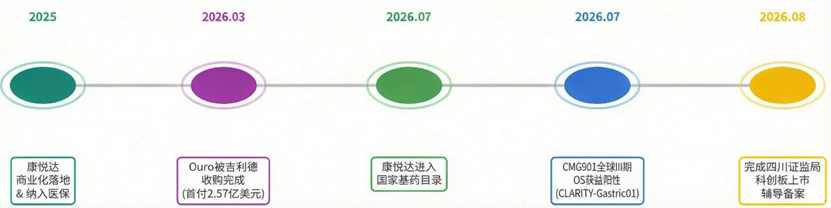
In the last week of August 2026, according to the China Securities Regulatory Commission's IPO counseling disclosure system, Keymed Biosciences Inc. completed its STAR Market listing counseling registration on August 20, 2026, formally initiating its secondary listing process on the A-share market. The company plans to retain its Hong Kong-listed entity and establish an A+H dual-listing platform, further expanding its presence in the domestic capital market.
This is a company with 3.24 billion yuan in cash on its books and 1.218 billion yuan in net profit for the first half of the year. According to the logic of its financial report, the thing it least needs to do is to go public again.
The logic of the innovative drug industry has never been reflected in financial reports. To understand why Connova is returning to A-shares, it's necessary to first clarify its current position in the industry: on one hand, its self-developed IL-4Rα monoclonal antibody, Conaida, is experiencing rapid growth as the first domestic product of its kind; on the other hand, its ADC CMG901, targeting Claudin18.2, has achieved a milestone with overall survival benefits in global Phase III trials; additionally, the acquisition of NewCo asset Ouro by a multinational pharmaceutical company has completed a full cycle.
Under the resonance of multiple catalysts, this former biotech company is now standing at a crucial crossroads on its path to becoming a global biopharma player.
Kangyida: The First Ticket to Enter Biopharma
For pharmaceutical companies transitioning from biotech to biopharma, the first hurdle has never been the number of products in the pipeline, but rather the ability to actually deliver laboratory molecules into the hands of patients.
Since its inception, Connova has focused on two core areas: self-immunization and tumors, building a fully integrated self-research platform that covers monoclonal antibodies, bispecific antibodies, ADC, and TCE cell redirection technology, from target discovery, molecular construction, process development, clinical development to commercialization, all of which are independently controllable. The first product to be realized from this foundation is Conbera (selpercatinib, CM310).
As the world's second and China's first IL-4Rα antibody, Kangyida simultaneously blocks the two core pathways of IL-4 and IL-13, covering a large population of allergic patients with atopic dermatitis, chronic rhinosinusitis with nasal polyps, and seasonal allergic rhinitis.
In a market where dupilumab has taken the high ground, Kangyida has not chosen to confront it head-on, but instead has secured the world's first seasonal allergic rhinitis (SAR) indication for an IL-4Rα antibody, creating an exclusive differentiation. At the same time, it has demonstrated its own clinical advantages in terms of conjunctivitis adverse reactions and long-term efficacy data, thereby breaking open the monopoly of imported large molecules in the domestic autoimmune field.
What truly opened up the ceiling was the dual boost from the payment and channel ends. The three approved indications were all included in the national medical insurance, and in July 2026, they were officially added to the National Basic Medicines List, becoming one of the few self-immunized innovative biological preparations in the directory. This paved the way for expansion into grassroots and county-level hospitals. On the channel side, a commercialization team of about 500 people covers over 1,500 hospitals nationwide, with more than 600 in-hospital medication points and 650 cooperating pharmacies, completing channel construction from top-tier hospitals to grassroots levels.
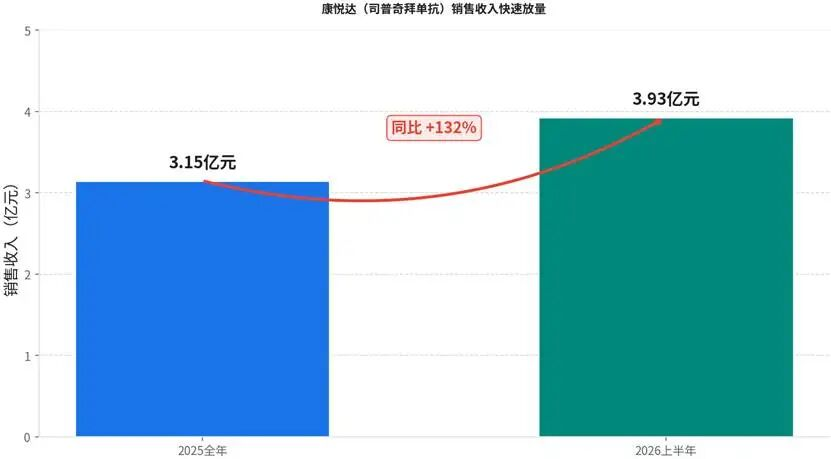
Financial data is the most honest footnote: in 2025, Kangyida's sales revenue was 315 million yuan for the full year; in the first half of 2026, it was 393 million yuan, a year-on-year increase of 132%. A single product sold more in half a year than in the entire previous year, typically entering a period of rapid expansion.
The pipeline iteration is still expanding the space for this product: the NDA for adolescent atopic dermatitis and nodular prurigo has been accepted, and pediatric atopic dermatitis and adolescent allergic rhinitis have advanced to Phase III clinical trials. As the applicable population expands, the market space increases, and the long-term stable operating revenue source is also solidified.
Of course, the Red Sea is the Red Sea. The IL-4Rα target is already crowded with domestic players, with multiple companies' molecules in the NDA filing or Phase III stage, and the next two to three years will see a concentrated launch of domestic products, intensifying price competition and the fight for doctor resources.
Kanoa holds the exclusive SAR indication and dual advantages of medical insurance and essential drugs, but dependence on a single product is still an unavoidable reality, which is also a question that regulators and the market will repeatedly ask: when will the second commercialized product arrive?
Two Ways to Go Global: BD and NewCo
If Kangyida represents Connova's domestic commercialization capabilities, then CMG901 and the NewCo model represent the company's ability to realize value in the global market.
China's innovative drugs going overseas have already moved past version 1.0, where they simply sold off overseas rights for a one-time gain. Now, they have entered version 2.0: asset spin-offs, shared equity, and shared risk. Connova is one of the most advanced practitioners in this wave, and has adopted both approaches.
The first candidate is CMG901 (AZD0901), a Claudin18.2 ADC, with global rights licensed to AstraZeneca, in a deal worth over $1.1 billion.
In July 2026, AstraZeneca announced the global Phase III CLARITY-Gastric01 top-line positive results, making the product the world's first ADC to demonstrate overall survival (OS) benefit in the second-line treatment of Claudin18.2-positive gastric cancer. Multiple indications, including first-line and perioperative, are being simultaneously advanced in global multi-center clinical trials, with overseas BLA submissions approaching and domestic submissions to follow. A benchmark case for domestic ADCs going overseas is taking shape.
The second approach is more representative: NewCo's offshore incubation. Unlike traditional business development's one-time licensing, the NewCo model strips early pipeline assets to newly established offshore entities, with the company providing technology and holding equity, and jointly incubating with overseas professional capital. The profit path changes from "one-time sale" to "milestones + sales sharing + overall acquisition" with multiple options.
CM336 (BCMA/CD3 bispecific antibody) validated this model: overseas rights were injected into Ouro Medicines, which was acquired by Gilead Sciences and Lakefront in 2026 for a total price of up to $2.1 billion, with Connova, as the founding shareholder, receiving $257 million in upfront payment while retaining subsequent milestone payments and sales royalties, marking the first complete cycle of a domestic NewCo being acquired by a multinational pharmaceutical company, providing a reference model for the industry.
In addition, multiple pipelines, including CM512 (TSLP×IL-13 bispecific antibody), CM313, and CM355, have also been launched overseas through the NewCo architecture, achieving early-stage asset value enhancement.
This arrangement also has another layer of cleverness: while early-stage assets amplify their value overseas, limited internal R&D resources can be concentrated on advancing the pipeline in the Chinese market, with the two tracks not competing with each other.
However, a dose of cold water must be poured here. The net profit of 1.218 billion yuan in the first half of 2026 mainly came from the non-recurring equity disposal gains brought by the acquisition of Ouro; after deducting non-recurring gains and losses, the company's operations have not yet turned a profit, and research and development investments and commercialization promotions are still continuously consuming cash flow.
NewCo can amplify asset value but is not equivalent to daily operating profit, which is a balance sheet that requires careful distinction and is also the boundary that the capital market needs to clarify when examining Canoia.
Why Return to A?
After the tutoring registration was announced, the market's question was straightforward: with 3.24 billion yuan in cash reserves and no financing pressure for survival, why take the initiative to embark on the long journey of returning to A-shares?
The essence of the answer lies in a Biopharma candidate's structural dilemma in the face of Hong Kong's Chapter 18A, and its proactive layout for capital platforms, valuation narratives, and industrial ecosystems.
One of them is to bridge the structural mismatch between valuation and liquidity.
The Hong Kong stock market, particularly the 18A market, has long been dominated by overseas US dollar funds, which tend to favor global equity and overseas clinical data when it comes to pricing innovative drugs. In contrast, they often significantly discount the commercialization value of domestic products, such as access to medical insurance, sales expansion in domestic hospitals, and market development in grassroots areas. As a result, many pharmaceutical companies with major domestic products, despite seeing sales growth, have struggled with low stock prices and can only conduct follow-on offerings at significantly discounted prices.
In contrast, the STAR Market has seen stronger support from renminbi-denominated public funds, insurance capital, and industrial capital, which have a deeper understanding of China's market dynamics. For innovative pharmaceutical companies that have already achieved commercialization and been included in the national medical insurance catalog, the valuation system and liquidity are significantly more favorable.
Kanoa's asset fundamentals fit perfectly into the narrative framework of A-share investors: the majority of its core assets, clinical resources, and commercialization markets are rooted in China, with CMG901 retaining domestic rights, Kangyida targeting the domestic market of millions of allergy sufferers, and NewCo handling overseas rights.
The A+H dual-platform structure allows for the simultaneous acceptance of overseas US dollar capital and domestic renminbi capital, optimizing the shareholder structure while also providing a more friendly exit channel for early-stage renminbi investment institutions.
Second, match the capital needs of the Biotech-to-Biopharma transition.
Current cash reserves are indeed sufficient, but looking at the longer timeline, the pressure of capital expenditures is gradually emerging: Kangyida is expanding into the grassroots market, and its sales team needs to continue growing; the next-generation dual-antibody pipeline, such as CM512, needs to advance to Phase II and Phase III clinical trials; and funds also need to be set aside for external collaborations and potential acquisitions.
The financing window of a single Hong Kong stock platform is subject to the influence of overseas market sentiment, with uncertainty; having A+H dual platforms allows for flexible fundraising through methods such as follow-on offerings and convertible bonds in different markets, providing a sufficient financing buffer for medium- to long-term development. Companies like BeiGene, Ronovo Biotech, and Junshi Biosciences have already proven the feasibility of this approach.
Thirdly, the multi-faceted gains at the industrial and brand levels.
For innovative drug developers, the capital market's identity label transmits directly to the industry level. An A-share listed entity carries stronger domestic brand credibility before hospitals, the medical insurance system, commercial insurers, and industry partners, which benefits business development, M&A, and talent incentives. Before domestic CXOs, biopharmaceutical parks, and industry funds, an A+H listing also opens more avenues for collaboration.
The choice of timing is also clever. With Kangyida's commercialization taking off, successfully entering the medical insurance and national essential medicines catalog, and achieving rapid sales growth; CMG901's global Phase III trial yielding positive overall survival data; and Ouro's acquisition by Gilead bringing in one-time accounting profits - multiple favorable factors have been released, allowing the company to rely on commercialized products to meet revenue and profitability standards when applying to list on the sci-tech innovation board, while also being compatible with the fifth set of biopharmaceutical listing standards, providing much more room for communication during the audit compared to pure research and development biotech companies without any marketed products.
Of course, the other side of the coin is equally clear: the so-called profits come from one-time equity gains, the main business excluding non-recurring items is still unprofitable, and a single product contributes the majority of sales revenue, all of which are destined to be the focus of regulatory inquiries and investor scrutiny.
As for why it's not simply privatizing the Hong Kong stock and completely returning to the A-share market, it's also a practical consideration: the overseas cooperation of CMG901 and multiple NewCo pipelines, as well as communication and collaboration with multinational pharmaceutical companies, still require the Hong Kong stock as a window to global capital. Meanwhile, privatization would consume a large amount of cash and face the challenge of negotiating with overseas shareholders, which would be costly and time-consuming.
Retaining its Hong Kong listing, adding a STAR Market listing, deeply developing commercialization domestically, advancing business development and global clinical trials overseas, the capital platform and business strategy are perfectly aligned.
Three Question Marks That Must Be Faced
The road to opening up new growth space has begun, but it doesn't mean the path ahead will be smooth. On the journey to transforming into a global Biopharma company, there are at least three objective constraints that exist.
The first question mark is the expected discrepancy.
The net profit of 1.218 billion yuan in the first half of the year is likely to cause market misjudgment, as once investors interpret the one-time equity disposal income as profit from the main business, a huge gap in expectations will form before and after the listing.
Regulatory reviews and secondary market pricing will focus on the company's performance after deducting non-recurring items, continuously questioning the risk of dependence on a single product and inquiring about the commercialization timeline of the second product. Meanwhile, domestic competitors in the IL-4Rα field are gradually advancing their market approval applications, and future price competition and market share competition will continue to test the commercialization team's operational capabilities at Connova.
The second question mark is the cost of red chips.
As a Cayman-registered red-chip company listed on the STAR Market, tasks such as restructuring, switching accounting standards, reviewing cross-border agreements, and dual information disclosure in two locations all imply higher audit, legal, and investor relations costs. The transaction structure of NewCo's offshore spin-off pipeline and the division of asset ownership will become the focus of regulatory inquiries, requiring full justification of the integrity of domestic business operations and clarification of interest associations.
More subtly, the two markets diverge in communication: Hong Kong-listed investors focus on overseas BD deals and global clinical progress, while A-share investors concentrate more on domestic sales and pipeline milestones. Maintaining both markets simultaneously multiplies the management team's workload. Additionally, the use of raised funds tilts more heavily toward domestic clinical trials, commercialization, and manufacturing construction, leaving less flexibility in capital deployment compared with a pure Hong Kong listing.
The third question mark is the uncertainty of the pipeline itself.
The next-generation dual-antibody pipelines, such as CM512, have uncertain subsequent clinical data readouts; although the NewCo model has already completed one acquisition cycle, not every overseas incubation project can replicate Ouro's success; the self-immune track has a cluster of targets, and future long-acting IL-4Rα monoclonal antibodies and TSLP/IL-13 multi-antibodies will be launched, making competition in the field increasingly fierce.
Over the past decade, China's biopharmaceutical sector has seen numerous biotech companies rise and fall: burning money on research and development, with impressive pipelines, only to fail on the eve of commercialization; holding heavy-hitting molecules, yet struggling with reimbursement and competition in the domestic market; going overseas with their pipelines, but only able to sell off foreign rights, missing out on long-term benefits in the global market.
Kanro's exploration is valuable because it simultaneously hits three main lines: achieving domestic commercialization through self-developed molecules, forming heavyweight business development partnerships with multinational pharmaceutical companies through heavy-hitting ADCs, and exploring the global value maximization of early pipelines through the NewCo model.
The Hong Kong listing is an important step for Chinese biotech companies to go global, but it's far from the end. The A+H share structure provides better liquidity, more diversified financing channels, and a valuation system more suited to the domestic market.
What truly determines whether a company can grow into a global Biopharma is still its underlying strength: whether Kangda can continue to make breakthroughs and maintain its advantage in the autoimmune field; whether CMG901 can be approved smoothly and fulfill subsequent milestone payments and sales sharing; whether CM512 can deliver impressive clinical data; and whether the NewCo model can continue to produce high-quality results.
Moving from follow-on innovation to original innovation, from pipeline development to a closed-loop commercialization model, and from simple product licensing to multi-layered globalization—a cohort of Chinese innovative drugmakers is answering the defining questions of this era. Conona's push for an A-share listing is not only the company's own ascent but also a microcosm of China's innovative drug industry coming of age.
The road ahead holds promise, but also turbulence. Markets must give companies time, while maintaining a rational and prudent perspective.