
Just after 11 p.m., a healthcare investor sent me a screenshot.
It wasn't clinical data or an upfront payment from a licensing deal.
It was an intraday chart of a Hong Kong-listed drugmaker.
Turnover for the day was just over HK$20 million.
"When this company raised its final private round, institutions were scrambling to get in," he said. "Now it's listed, and a day's trading is less than what one fund once wanted to invest."
This may be the most absurd scene in China's biotech sector.
On one side, the queue for Hong Kong IPOs keeps getting longer.
As of end-July 2026, the Hong Kong exchange had processed 838 IPO applications year-to-date. The bell has rung for 131 applications, while 485 remain under review and another 12 have passed the listing committee and are awaiting the bell.
Biotech companies are also crowding through this door.
In 2018, Chapter 18A opened Hong Kong listings for the first time to biotechs that didn't meet traditional financial tests. Eight years on, more than 80 companies have entered the secondary market through that door as of early 2026.
The question is whether there's enough money and attention to go around as more companies pile in.
On the other hand, there's the reality of a sharp post-listing cooldown.
The company finally gets its ticker. The founder rings the bell. Investors get their exit. But a few months later, it becomes clear the door is open, yet the path is narrower than expected.
The message to drugmakers preparing to list in Hong Kong: unless it's absolutely necessary, there's really no need to join the herd at this point in 2026.
The issue isn't whether Hong Kong is a good market. For many biotechs, being able to list and being right to list have never been the same thing.
Hot Money in Hong Kong Stocks Unlikely to Reach Most Pharma Stocks
Let's start with a frequently misunderstood question: Does Hong Kong actually lack liquidity right now?
No!
In 2025, the average daily turnover of southbound Stock Connect trading reached HK$121.1 billion, more than double the HK$48.2 billion in 2024; by July 2026, the average daily turnover still stood at about HK$129.2 billion.
The money hasn't disappeared.
The real problem is that money is becoming more selective.
Tencent, Xiaomi, Alibaba, SMIC, and a few popular innovative drug companies can see daily turnover of several billion Hong Kong dollars, or even more than HK$10 billion.
But look down the market-cap scale: the 18A companies with market values of a few billion Hong Kong dollars, and the biotech stocks that have faded from market attention a year or two after listing.
You'll find it seems like a different Hong Kong stock market.
Some stocks see only tens of millions of Hong Kong dollars in daily turnover. The even less active ones see just a few million. Occasionally a rush of hot money lifts trading volume, but it lasts at most two or three days.
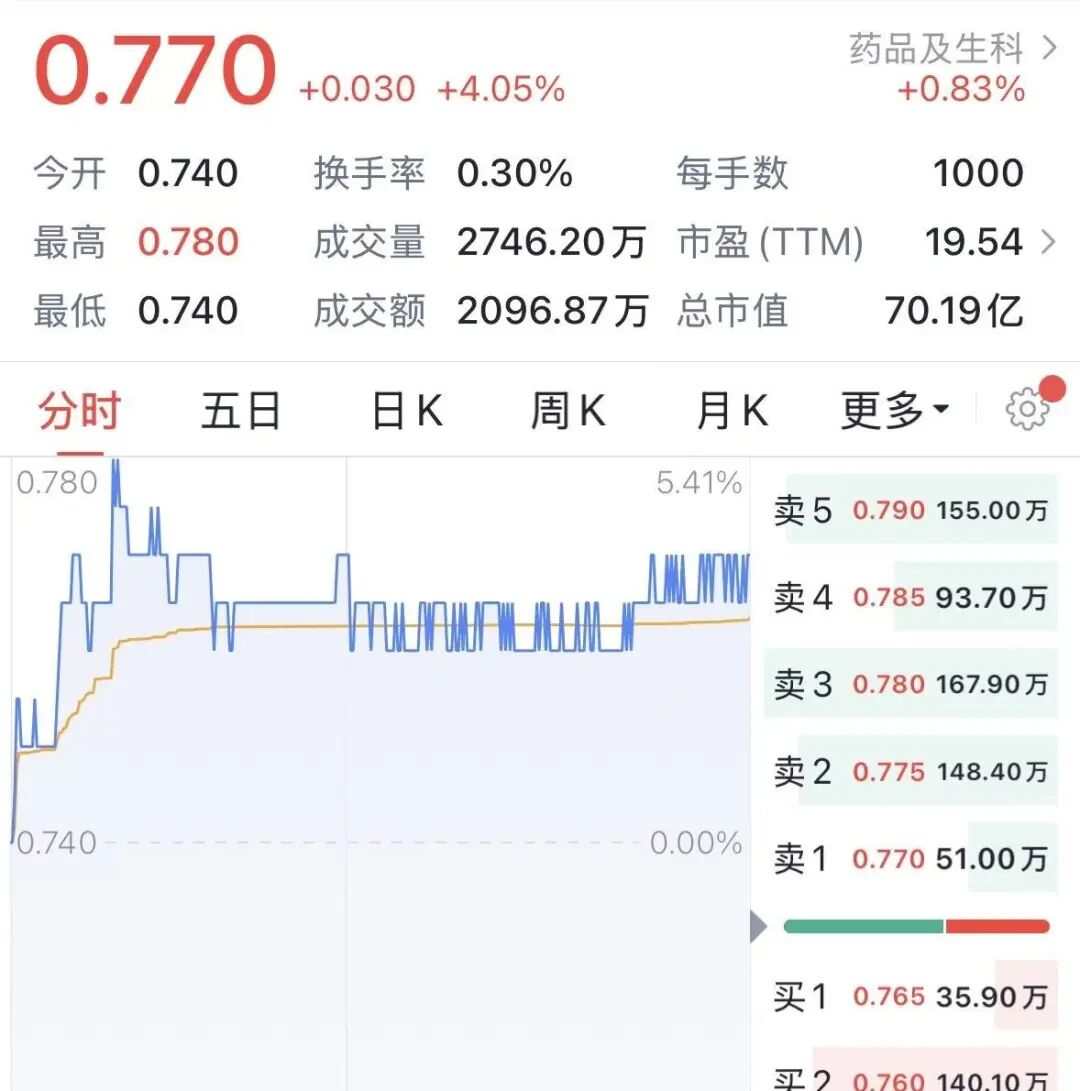
What does this mean?
Suppose an institution managing billions of yuan wants to allocate to a pharmaceutical company with only HK$20 million in daily turnover. How much would it dare to buy?
A HK$50 million purchase could take days to build the position.
Selling is even trickier.
What if clinical data disappoint? What if a major shareholder trims? What if risk appetite suddenly sours?
The real meaning of poor liquidity isn't that no one is buying today; it's that when everyone wants out, there's no door big enough.
This creates a vicious cycle:
The lower the volume, the less willing large institutions are to allocate.
The less large institutions allocate, the thinner the research coverage.
The thinner the research coverage, the lower the market's attention.
The lower the attention, the further trading volumes decline.
Eventually, a company completes its IPO only to become an island in the capital markets.
So when discussing Hong Kong-listed pharmaceutical companies today, one cannot simply look at how much the Hang Seng Index has risen or how much southbound capital has flowed in.
Rather, the question is how many stocks that money ultimately flows into. Hundreds of billions in daily turnover moves around, yet many small and mid-cap pharma companies still lack their own slice of liquidity.
Going Public Now Means Showing Your Hand Early
The second problem is even harsher than liquidity.
In the past, many pharma companies treated an IPO as a graduation ceremony. After raising Series A, B, and C rounds and reaching Phase II clinical trials, they finally list.
Flowers, bell-ringing, group photos — the listing ceremony looks like a perfect full stop. But for biotech companies that have yet to turn a profit, the bell's echo often marks only the beginning of public pricing.
From then on, the market converts every development into share price. A delay in clinical trials can trigger valuation downgrades; a license-out deal below expectations pressures the stock; dwindling cash balances raise concerns about the next financing round; a competitor's head start forces a revaluation of core pipelines.
Even without company-specific bad news, a loss of investor favor for the entire biotech sector can drag the stock down along with peers.
In the primary market, you can sit down and tell a three-hour story; in the secondary market, all it takes is one click on Sell.
Huajian Weilai-B, which listed on June 23, 2026, is a rather extreme case.
The IPO was priced at HK$81.80 per share, with Hong Kong public offering subscription reaching 2,007.60 times, and a lucky draw allotment rate of just 2% for one board lot.
Sounds red-hot, right?
But on its first trading day, Huajian Weilai opened at HK$81.80, slid all session, and closed at HK$35.26 — down 56.89% from the offer price, near the day's low.
Primary-market demand is intense, but the secondary market can't absorb the supply. Hefty subscription multiples haven't translated into post-IPO liquidity.
The problem isn't necessarily a sudden change in the company itself. Only a few days pass between filing and listing. What has changed is that the primary market, the IPO market and the secondary market all apply completely different pricing logic to the same company.
An IPO can create scarcity. Cornerstone investors can lock up stock. The public offering can attract subscriptions hundreds or thousands of times oversubscribed.
But once the bell rings, it all comes down to two questions: What is your drug worth? And where is the next group of buyers willing to take it off your hands?
That is what pharma companies listing today need to rethink.
If a lead product is two years from a key clinical readout and cash on hand lasts two and a half years, why accept a permanent public-market valuation today?
Listing after the key data could mean a 20 billion valuation. Listing now to raise 800 million could see the market mark it down to 3 billion.
You gain 800 million in cash, but you may lose control over your valuation for years to come.
An IPO is never free money. The ticker itself is the price.
Drug Development Takes Five Years, but Hong Kong Stocks Demand Daily Answers
This is the most contradictory aspect of pharmaceutical companies.
After an internet company goes public, it can tell investors each quarter how much users, revenue, and profit have grown.
But a clinical-stage pharmaceutical company completes Phase 1 enrollment today. Then what?
Wait!
Tomorrow, it completes dosing of the first patient. Then what? Still waiting.
Clinical data that truly changes a company's value may take 12 months, 18 months, three years, or even five years to arrive.
But the stock must trade every trading day.
This is the natural mismatch between the drug development cycle and the secondary-market pricing cycle. Drug development moves on a yearly timeline. Funds are judged quarterly. Stocks trade in milliseconds. When a company lacks sustained fundamental catalysts, the market can only look for other variables.
So capital starts trading on expectations, on sentiment, on clinical results from comparable companies, and eventually on capital itself.
For companies that have mature commercial products, stable cash flow, or multiple key data readouts in the next 12 months, this is not necessarily bad. They have something to keep reporting.
But for small biotechs with only one or two core pipeline assets and the next key milestone still two years away, going public too early likely means:
A company that should be patiently conducting experiments is thrown prematurely into a machine that re-prices it every day.
This is not necessarily good for innovation, or even for management.
Because from the day of the IPO, the CEO suddenly has an extra job: explaining the stock price.
Beware 'Listing for Listing's Sake'
In recent years, investors have heard many companies say something like, 'The window is good now, so let's get the IPO done first.'
This statement sounds reasonable at first, but the more you hear it, the more dangerous it becomes.
Because it presupposes that simply being able to list makes the IPO a success.
That is far from the truth.
An IPO should solve critical problems.
If a company needs 2 billion yuan to fund global clinical trials over the next three years, and an IPO can provide enough ammunition in one go, then it is certainly worth discussing.
If listing can attract truly long-term international institutions and improve the shareholder structure, it is also worthwhile.
If the company has reached the commercialization stage and needs a long-term capital platform to support M&A, that is equally reasonable.
But what if a company ends up raising only a few hundred million Hong Kong dollars?
Cash will last only another year.
Meanwhile, it takes on the full costs of audits, compliance, investor relations, disclosure and keeping the market's attention.
More importantly, it loses the right to remain unpriced, at least for now.
A private company valued at 20 billion yuan stays at 20 billion on the books even after a year without fundraising.
A public company worth 20 billion today can be 10 billion tomorrow, and just 3 billion the day after if clinical data disappoint.
When the next fundraising comes, the problem appears: at a 3 billion market value, what does issuing 1 billion in new shares mean?
Massive dilution.
So the company can only raise less. Raising less means trimming the pipeline, and as the market sees R&D spending fall, it cuts the valuation again.
This is the truly dangerous death spiral.
For many biotechs, the real fear isn't failing to go public—it's failing to raise the next round once listed.
So, when should pharma companies list in Hong Kong?
The answer, of course, is not to stay away.
Hong Kong remains a vital capital market for China's biotech sector.
The 18A rule transformed how Chinese innovative drugmakers raise capital, sweeping a cohort of biotechs into public markets before they had revenue, profits, or even approved products.
As of 2026, Hong Kong has built a vast ecosystem of hundreds of listed healthcare companies.
The problem has never been the Hong Kong exchange itself. What needs to change is the inertia of recent years: companies rush to IPO whenever the window opens, and no one wants to fall behind once peers file.
For today's biotechs, listing is no longer a simple 'should we or shouldn't we.' It's a more practical question: Are you scrambling for a lifeline from the market, or can you command lasting pricing power in China and global capital markets?
Some companies clearly should list.
Companies with a clear clinical-value inflection point in the next 12 to 18 months should list if an IPO can fund them to that milestone.
Companies with commercial revenue or steady business-development cash flow that can keep proving themselves to the secondary market after listing can also list.
Leading biotechs with true global competitiveness, able to attract long-term international capital and achieve global asset pricing, have no reason to shun public markets.
There is another category that also must list — perhaps even more urgently.
They have run out of cash.
Cash on hand may cover only a year. They cannot raise a next round in the private market, and existing shareholders are unwilling to provide more funding. But clinical work, salaries, and R&D cannot stop.
At this point, a Hong Kong IPO is not a strategic choice.
It is, instead, a question of survival.
So telling such companies to 'wait another year' is meaningless. It's not that they don't want to wait; they simply can't afford to.
Even if the valuation is lower, even if the IPO raises only a few hundred million Hong Kong dollars, even if the post-listing market cap is only a few billion, it must get that money in hand first.
Surviving first is not wrong. But the real cause for concern starts right here.
An IPO can save this year. Who saves next year?
An innovative drug, from early-stage clinical trials to pivotal trials to approved commercialization, has never needed just one sum of money.
It needs one round of funding after another.
If a company raises HK$500 million or HK$800 million in an IPO today, it may extend its cash runway by 18 months. If, after 18 months, the core pipeline has not produced clinical data that changes the company's value, it will still need to raise more.
The problem was that by then it was no longer a private-market biotech; it was a stock with a daily price.
Suppose it was worth HK$8 billion at listing. A year later, half of the IPO proceeds had been burned through, key clinical data had yet to come out, market enthusiasm was cooling, average daily turnover had fallen to just tens of millions of Hong Kong dollars, and the market cap had dropped from HK$8 billion to HK$3 billion. What if the company still needed cash?
It would raise more capital.
But raising HK$1 billion at a HK$3 billion market cap is a very different story from raising HK$1 billion at an HK$8 billion market cap. The former means far greater dilution. And once the market expects the company to keep raising capital, its valuation may come under further pressure.
A very dangerous cycle thus emerged:
The more cash-strapped the company, the more it needs to raise capital;
The lower the valuation, the higher the cost of raising capital;
The higher the cost of capital, the greater the dilution for existing shareholders;
The more severe the dilution, the more the market worries about the next financing round.
So if a biotech company must rely on an IPO to survive next year, what will it rely on to survive the year after?
Because an IPO only solves a cash problem at a specific point in time; it does not solve a company's financing capability, let alone its asset quality.
If an IPO raise can carry the company to a key clinical data readout, then once the data are released, the company's valuation will be reassessed, and the door to refinancing will naturally reopen.
Then the money would have served its purpose.
But if the company has no major value inflection point in the next two to three years, and the IPO proceeds are insufficient to sustain it until that point, then listing likely just shifts the problem from the primary market to the secondary market.
Previously it couldn't find VCs to fund it; going forward, it will fail to find secondary-market investors to fund it.
The office lights are still on, clinical trials are still running, and the cash balance is temporarily a few hundred million yuan higher... It may seem that everything has been resolved, but in reality, the countdown has simply restarted.
At midnight, the investor sent me another message.
He said, 'We used to worry the company couldn't go public. Now I'm more worried that it will.'
I stared at the message for a moment. It occurred to me that this might perfectly capture the transformation under way in China's biotech industry.
For the past decade, the industry has been learning one thing: how to raise capital.
How to raise from dollar funds, how to raise from yuan funds, how to execute an IPO.
Funding came in round after round, and valuations climbed notch by notch.
But today, Chinese biotech may need to learn something even harder: how to keep surviving after going public.
The capital market won't automatically treat a successful listing as proof that a company has cleared the survival threshold.
An IPO is never the finish line. For a biotech that still needs years of cash burn, it may only be the start of the countdown to the next funding round.
So when exactly should a drugmaker list in Hong Kong?
Perhaps there is ultimately only one criterion:
It is not whether you can list today, but whether the capital raised today can carry you to the next point that truly changes the company's fortunes.
If it can, Hong Kong remains a path worth taking.
If it cannot, the bell-ringing may only temporarily drown out the sound of a cash crunch.
Note:
License-out upfront payment: When a drugmaker grants another company partial or full rights to a drug, the latter pays an upfront sum upon signing.
Biotech: Companies whose core business is biotechnology and innovative drug R&D, typically in drug development and clinical trials, with high R&D spending, long timelines, and high risk.
18A: A listing pathway under Chapter 18A of the Hong Kong Stock Exchange's Main Board Listing Rules, designed for biotech companies that aren't yet profitable. Following the 2018 listing-reform, it allows biotech firms that fail traditional financial-qualification tests to list in Hong Kong if they meet certain conditions.