
At this time last year, Miniso was still a darling of the capital markets.
After its 2025 interim results were released, Miniso's shares once jumped nearly 20% in a single day.
At that time, Miniso posted revenue of 4.97 billion yuan, up 23.1% year-on-year, with gross margin of 44.3%, while TOP TOY revenue surged 87%.
The market even questioned how far Miniso still was from Pop Mart.
A full year later, the answer came: the gap had not narrowed — it had widened.
After this year's interim results, Miniso's shares plunged more than 12% in a single day.
As of the close on Sept. 3, its market capitalization stood at just HK$22.5 billion, down nearly 50% since the start of the year.
Looking back at its listing, Miniso's shares once rose nearly tenfold within a year.
Miniso's stock has dropped more than 60% from its post-interim-report peak last year, more than halving.
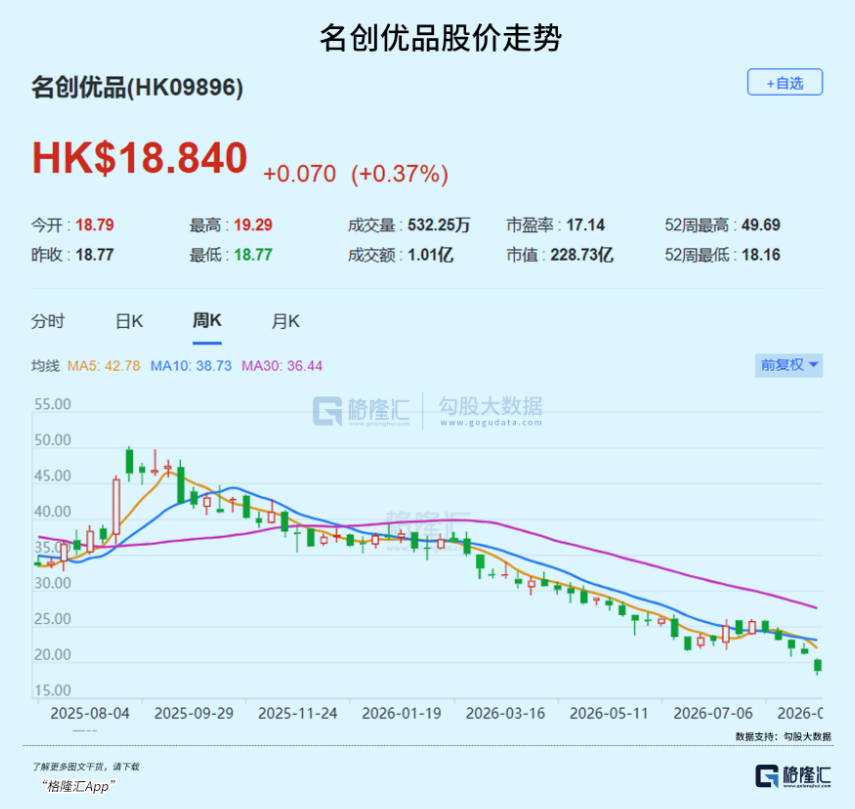
The gap between heaven and hell is wider than a single earnings report.
In the first half of 2026, Miniso posted revenue of 11.50 billion yuan, up 22.4% year-on-year.
Gross margin held steady at 44.3%, while net cash from operating activities rose 45.5% year-on-year to 1.48 billion yuan.
By these metrics, the appearance of growth remains intact.
But the real substance — profits — has clearly decoupled from revenue.
Profit for the period was 957 million yuan, up just 5.6% year-on-year; adjusted net profit excluding exchange gains and losses was 1.222 billion yuan, down 1.7%.
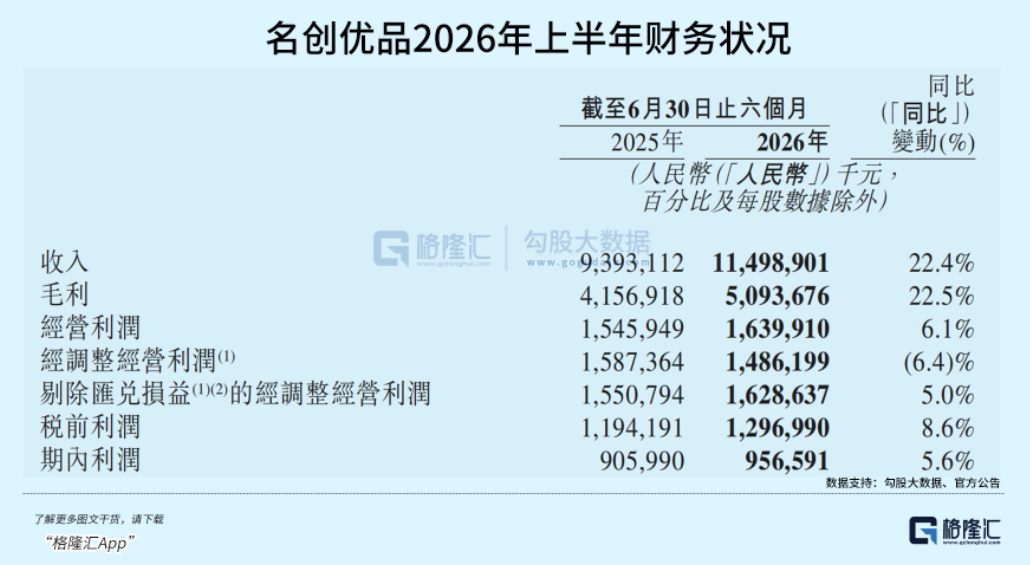
Operating profit growth of 6.1% was far below revenue growth of 22.4%, meaning exchange-rate and adjustment items nearly wiped out all incremental operating profit.
The problem lies in the second quarter.
In the first quarter, operating profit was about 1.52 billion yuan and profit for the period was about 1.25 billion yuan, a robust performance.
But in the second quarter, conditions deteriorated sharply. Revenue rose 17.0% year-on-year to 5.81 billion yuan, a clear slowdown, while operating profit tumbled 86% to 119 million yuan from 836 million yuan a year earlier.
More striking, the company swung to a net loss of 292 million yuan in the second quarter, versus a profit of 490 million yuan a year earlier.
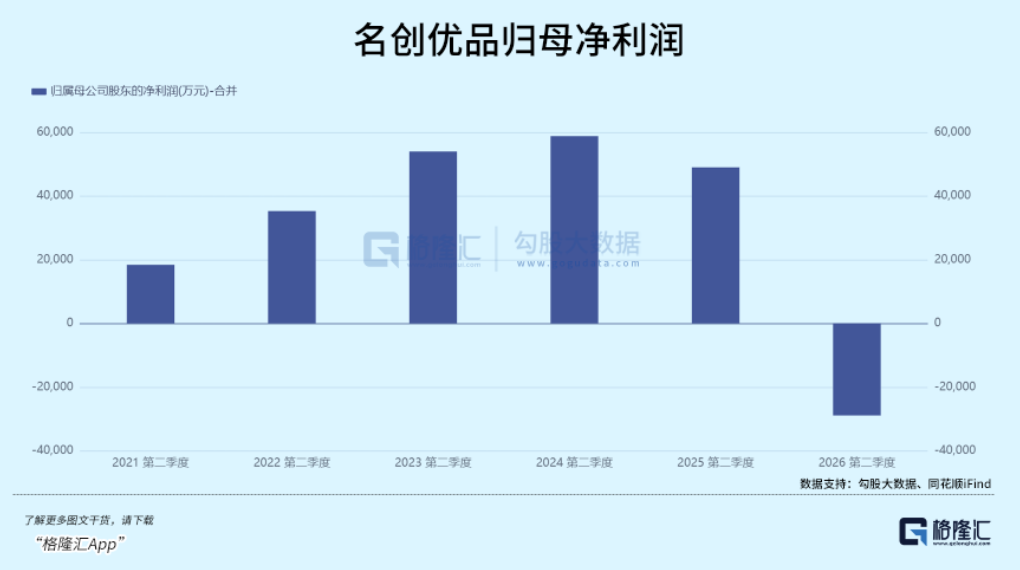
The immediate trigger for the sharp profit decline was Miniso's investment in AI company MiniMax.
Between late 2021 and early 2022, Miniso quietly took a stake in MiniMax, which was then in its early stage.
After MiniMax listed on the Hong Kong Stock Exchange in January this year, its share price briefly surpassed the HK$1,000 mark.
In the first quarter, this investment generated 875 million yuan in investment income for Miniso.
However, Miniso's share price fell in the second quarter, leading the company to recognize a fair-value loss of about 597 million yuan.
The swings in investment income caused Miniso's reported profit to fluctuate sharply.
But even excluding the non-operating fair-value loss and exchange losses, adjusted net profit in the second quarter was about 590 million yuan, still down about 10.5% year over year.
That suggests Miniso's core earnings are also contracting.
Where did the money go?
First, the selling expense ratio rose sharply.
In the first half, selling and distribution expenses reached 3.045 billion yuan, up 39.6% from a year earlier, and as a share of revenue rose to 25.8% from 23.1%, an increase of 2.7 percentage points. Miniso attributed the increase to spending on IP development, promotion and direct-store expansion.
Chief Financial Officer Zhang Jingjing provided a more detailed breakdown at the earnings call: lease and depreciation expenses rose 1 percentage point, advertising and promotion expenses 0.5 percentage points, IP licensing fees 0.5 percentage points, and sales labor costs 0.4 percentage points.
Each item may seem small, but together they add up to a heavy cost. The IP party, in other words, is never free.
Second, the revenue mix is deteriorating.
By segment, Miniso's franchise and agency businesses — with margins above 30% in the first half — saw their share of total revenue fall six percentage points.
In contrast, the overseas direct-operated business, which remains in low single-digit losses, increased its revenue contribution by three percentage points.
This means Miniso's fastest-growing business is precisely its least profitable one, while its most profitable business is decelerating.
The rise in one and fall in the other weighed heavily on overall margins.
Yet the overseas market, the least profitable, is exactly Miniso's most important growth engine and the source of its valuation premium.
When the overseas engine suddenly stalls, Miniso's growth in both earnings and share price loses its momentum.
Domestically, Miniso operates a light-asset franchise model, but overseas it has shifted to a heavy-asset direct-store model.
Such a transition inevitably brings short-term cost surges and profit pain.
As of June 30, 2026, Miniso had 8,674 stores worldwide.
Of these, 8,309 were Miniso-branded stores: 4,665 in China (a net addition of 97 in the first half) and 3,644 overseas (a net addition of 61).
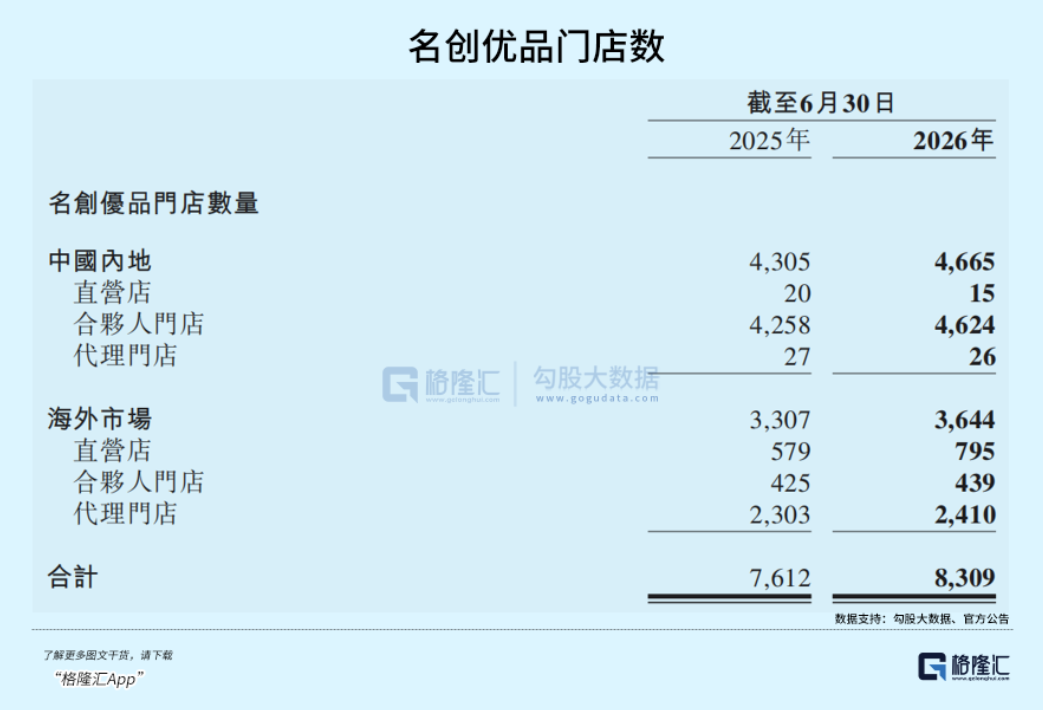
By store count, Miniso is already one of the world's largest IP retailers, but scale alone does not automatically equal value.
In the first half, Miniso-branded overseas revenue rose just 14.9% to 4.06 billion yuan, below the company's earlier guidance for high double-digit growth, and the overseas revenue share fell to 38.6% from 40.9% in the first half of 2025.
More concerning, overseas same-store GMV declined by a low single-digit percentage.
That means overseas growth relies almost entirely on new store openings, while output from existing stores is not improving but shrinking.
At the earnings call, Ye Guofu conceded that overseas operations' profit contribution has fallen to 10%-15% in the first half of this year from 35%-40% in 2023.
He cited two reasons: declining revenue from distributor businesses, and direct-operated stores outside North America are still in the early investment phase, with the store model still being refined and not yet profitable.
Maturation of the single-store model indeed takes time, and Ye compared it to the shift from "scale first to quality first" that the mainland China market underwent three years ago.
But whether capital markets have the patience to wait for this transformation to be completed is another question.
Miniso clearly recognizes this. Ye said at the earnings call that the company will slow overseas store expansion, focusing in the second half on operating the nearly 800 overseas direct-operated stores already opened, and will replicate the model again once it matures.
This amounts to a deliberate brake.
But on IP development, Miniso is still accelerating.
On August 22, MINISO LAND at Chengdu's Eastern Suburb Memory officially opened, with three floors, over 1,800 square meters, more than 5,000 products, and IP merchandise accounting for over 80% of the assortment.
In less than two years, Miniso has opened more than 100 amusement-park-style stores and signed over 30 designer toy artists.
At the start of the year, Miniso set a target for proprietary IP sales to exceed 1 billion yuan, a goal it achieved ahead of schedule by the end of July.
However, every coin has a flip side.
The accelerated IP strategy has come with hefty costs — licensing fees, promotional expenses, artist collaboration fees — each eroding profits and driving the surge in the selling-expense ratio mentioned earlier.
More notably, Miniso's designer toy brand TOP TOY posted revenue of 985 million yuan in the first half but recorded an operating loss of 72.34 million yuan, its first loss in nearly three years.
Regarding the more than 30 signed designer toy artists, Ye Guofu said this is a 'multi-IP horse-racing model,' and most of them won't become hits.
This also highlights the difference between Pop Mart and Miniso.
Though Miniso and Pop Mart are frequently compared, the gap between the two is widening in the first half of 2026.
Pop Mart posted first-half revenue of 17.17 billion yuan, up 23.8% year-on-year; adjusted net profit was 5.16 billion yuan, with adjusted net margin of 30% and gross margin of 69.7%.
Pop Mart's revenue is roughly 1.5 times Miniso's, but its profit is more than four times larger.
The gap stems from fundamental differences in their business models.
Pop Mart is IP-centric, building a closed loop spanning content, products and channels, and has mature operating capabilities for its proprietary IPs.
That is why Pop Mart's gross margin approaches 70%.
Miniso, however, remains essentially a retail channel operator. Even as its IP integration deepens, its 44.3% gross margin is still far below the level of pure IP operators.
A higher gross margin means stronger pricing power and a deeper profit moat — a chasm Miniso must cross on its IP transformation path.
Ye Guofu is clearly aware of this. At the earnings call, he vowed that sales at Miniso's park-format stores would surpass those of Pop Mart stores in the same locations.
If he does 3 million yuan a month, we do 3 million; if he does 2 million, we do 2 million.
This pledge to match rivals reflects both ambition and anxiety.
For Miniso, beating rivals on per-store sales is one thing; getting close on overall business-model margins is another.
Park-themed stores generate roughly twice the sales per square foot of regular outlets, with an average payback period of under a year, versus 16-18 months for conventional stores.
Whether higher per-store efficiency can offset the ceiling on overall margins remains to be seen.
TOP TOY's first-half loss shows that replicating Pop Mart's success is far harder than paying lip service.
Whether Miniso can become the next Pop Mart remains unclear.
But the most pressing issue is that it must first surpass its former self.
As a strategy, overseas direct-operated stores, proprietary IP, and large-format theme-park stores make sense.
IP-based retail is an irreversible trend; globalization is the necessary route to scale; large-format stores are the optimal path for brand upgrading.
For Miniso, the transition pains — surging selling expenses and overseas revenue pressure — are the inevitable cost of transforming from a discount retailer into a global IP operations platform.
The crux is the pace and intensity of execution.
If overseas direct-operated stores can quickly prove their unit economics, proprietary IP's revenue mix keeps rising to offset licensing costs, and theme-park store expansion maintains quality without sacrificing efficiency, then the operating inflection point is within reach.
But if the adjustment pain exceeds expectations — say, intensifying overseas competition and longer payback periods for IP investment — the capital markets may need a lower valuation to price in these uncertainties.
Miniso's market value has fallen from HK$58 billion to HK$22.5 billion in a year; the market has already voted with its feet over near-term prospects.
Only time will provide the answer.