On August 28, the real estate industry underwent a complete transformation.
The Ministry of Housing and Urban-Rural Development and two other departments jointly released a notice on improving the commodity housing sales system, marking the beginning of the "existing house sales" era in China, and officially ending the "pre-sale system" that has driven rapid growth in the real estate sector for over 30 years.
The real estate industry is capital-intensive and cannot operate without financial support. Consequently, the central bank and the financial regulatory bureau simultaneously released six heavyweight documents to reconstruct the credit system for the real estate sector, providing support for the current sales model.
The transformation of the sales system, along with the implementation of supporting credit measures, will undoubtedly usher in a new development model for China's real estate industry, marking a landmark event of epochal significance.
However, these grand themes and narratives are better left to experts and influencers. I prefer to take an individual perspective, observing how ordinary people feel about and respond to the trends of the times, which may better reveal the gap between policy and reality.
Many people do not understand how to calculate their housing loan payments
After the new rules took effect, the most heated discussion centered on extending mortgage terms from 30 to 40 years. With the loan amount unchanged, stretching out the repayment schedule has one immediate effect: lower monthly payments.
Therefore, some believe that with the down payment ratio already reduced to 15% and interest rates lowered to 3% per annum, the current extension to 40 years means that policy has "opened the door to the greatest extent possible for ordinary people to buy homes," so those with rigid demand should seize the opportunity.
In particular, various real estate agencies have employed multiple tactics to forcibly argue that the benefits of lowering the threshold outweigh the drawbacks of the overall increase in interest rates.
But many ordinary people, who are shy about speaking out, can't help but jokingly say, "It would be great if it could be extended to 400 years." There are also many who echo this sentiment, with some even fantasizing, "How about 200 square meters for just a few dozen yuan per month, wouldn't that be wonderful?"
This is, of course, a joke. But it also reveals a reality: the reason they entertain such fantasies is that it fully exposes how many people don't understand how mortgage calculations work, let alone the fundamental nature of financial lending.
So, let's start with a brief introduction.
The most common mortgage repayment method is "equal principal and interest," which, as the name suggests, has two layers of meaning. The "equal" part is tangible, meaning the monthly repayment amount is the same every month.
The term "principal and interest" is relatively obscure, referring to the fact that each repayment installment consists of two parts: principal and interest, with the difficulty lying in how to distinguish and calculate the two, which is a blind spot for most people.
Taking a 1 million yuan mortgage with an annual interest rate of 3% and a 30-year repayment period as an example, with the help of a loan calculator, a repayment schedule can be directly generated, as shown in the figure below. The monthly repayment amount is fixed at 4,216.04 yuan, and the detailed data for each month is quite long. We only need to take the first two months as an example to explain the calculation principle of equal principal and interest.
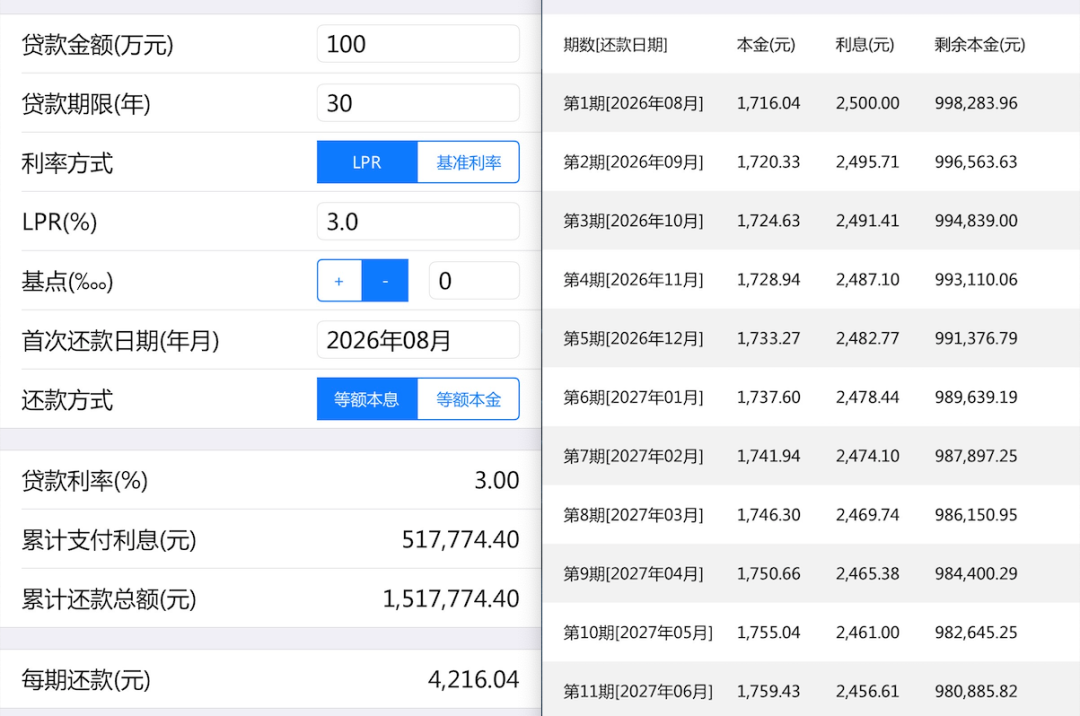
Looking at the details for the first month, the principal repayment portion and the interest portion are 1716.04 yuan and 2500 yuan, respectively. Note the number 2500, which will be emphasized again later, as it is the most certain number in the entire statement, regardless of whether the repayment period is 30 years, 40 years, or even 400 years, the interest portion for the first month will always be 2500.
The source of the 25,000 yuan is very clear. The loan principal is 1 million yuan, and at an annual interest rate of 3%, the annual interest is 30,000 yuan, so the interest for the first month is exactly 2,500 yuan.
So where does the principal portion of 1716.04 yuan come from? The answer is also simple, because to make up the monthly fixed repayment of 4216.04 yuan, subtracting 2500 from 4216.04 yields 1716.04.
Moving on to the second month, the interest cycle immediately enters the second month after the first month's payment is cleared, because 17,716.04 yuan of principal has already been repaid, so the loan principal for the second month is the remaining 9,982,283.96 yuan.
At the same annual interest rate of 3%, the interest for the second month can be calculated directly as 2495.71 yuan. In order to make up the fixed payment of 4216.04 yuan, an additional 1720.33 yuan of principal needs to be repaid.
Then, for the remaining 358 months, it's not necessary to look at them, as they all follow the same pattern, simply repeating the process, with each month calculating interest on the remaining principal, then adding a portion of the principal to make up the fixed repayment amount.
The biggest challenge arises here: where does the dominant fixed monthly payment of 4216.04 come from?
Its origin is indeed complex, but it can also be simply put that after complex and precise mathematical calculations, we found that only by setting the quota to 4216.04 can the aforementioned interlocking process be seamlessly established.
If mortgages were extended to 400 years
Once the mortgage calculation method is understood, it's not difficult to comprehend the true implications of extending the repayment period.
Under the "equal principal and interest" repayment method, the interest portion is rigid and directly calculated based on the current outstanding principal and mortgage interest rate. The adjustable part is actually the principal portion, which can be adjusted by extending the repayment period to reduce the monthly payment pressure, essentially equivalent to cutting the principal repayment amount for each period.
As mentioned earlier, reducing the principal repayment amount comes at a cost, because every lesser amount of principal repaid will be carried over to the next period as the remaining principal, becoming the basis for calculating interest.
So, for a mortgage of 1 million yuan at an annual rate of 3%, extending the term from 30 years to 40 years cuts the monthly payment from 4,216.04 yuan to 3,579.84 yuan, but total interest climbs from 517,000 yuan to 718,300 yuan. In other words, an extra 200,000 yuan in interest buys a reduction of just 636 yuan per month.
Moreover, the equal principal and interest repayment method has a counterintuitive feature: the monthly payment amount does not continue to decrease as the repayment period is extended, but instead can only approach a fixed value.
You can try it yourself, with repayment periods set at 100 years, 200 years, and 400 years, the corresponding monthly payment amounts are 2,631.51 yuan, 2,506.26 yuan, and 2,500.02 yuan.
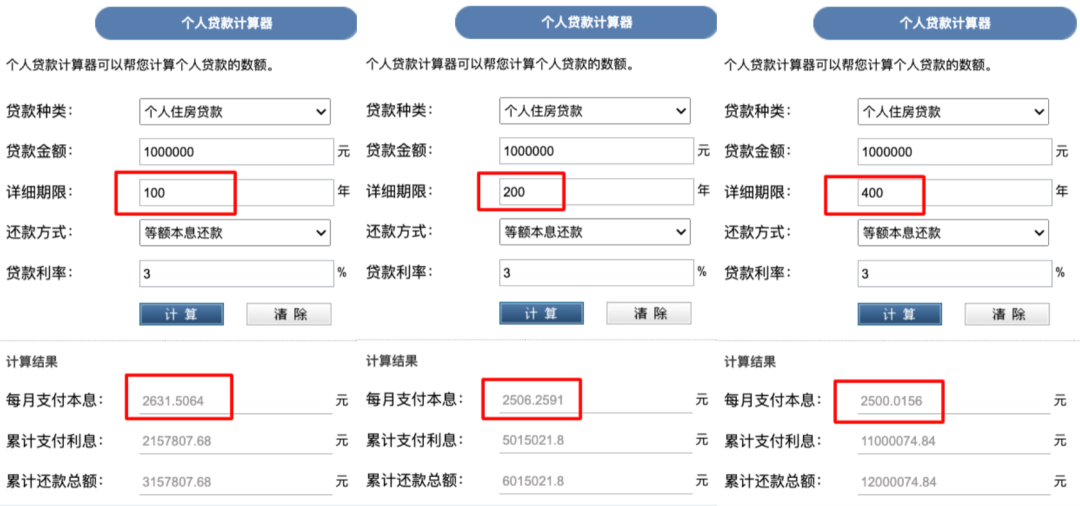
Isn't it steadily approaching 2,500? And that's precisely the interest generated by a principal of 1 million in the first month, as we discussed earlier.
The reasoning behind this is not difficult to understand, because the repayment period is too long, meaning that for most of the time, the principal repaid each period is almost negligible, and the remaining principal to be repaid remains virtually unchanged at 1 million.
And during this period, every minute and every second, interest will be calculated based on the remaining principal, even if you have already paid hundreds of millions of yuan in interest, as long as the principal has not been fully repaid, interest will still be accrued.
The notion of "extending mortgages to 400 years, with monthly payments of just a few dozen yuan, wouldn't that be great" is neither grounded in reality nor theoretically possible.
The essence of financial lending is a value exchange across time, where the borrower exchanges future cash flow for the lender's current cash, and the lender is willing to make the exchange because they can collect interest, with the amount of interest determined by the interest rate and time.
Making early loan repayments and buying houses with full payment
However, when the statutory time limit for mortgages, a type of value exchange over time, is extended to 40 years, we can see that many people have started to flee from or avoid this type of value exchange.
The People's Bank of China's latest "2026 Q2 Financial Institution Loan Direction Statistics Report" shows that as of the end of June this year, China's personal housing loan balance was 26.29 trillion yuan, down 7163 billion yuan from the beginning of the year. Looking at the longer time frame, the growth rate of the housing loan balance has been negative for 13 consecutive quarters on a year-over-year basis.
There are two reasons for the continuous decline in the stock of mortgages: one is that old buyers are repaying their loans in advance, and the other is that new buyers are paying in full for their homes. The underlying reasons for these phenomena are similar.
Some individuals are opting for early loan repayment, primarily due to considerations of "asset optimization". Although mortgage interest rates have decreased significantly over the past two years and remain at low levels, the yield on deposits, financial products, and other assets has decreased even faster.
In the period before the pandemic, homebuyers faced mortgage rates hovering at a lofty 5%–6% annually on the liability side. Yet at the same time, with a loose financial environment and a steady stream of financing products hitting the market, wealth management and asset management products on the asset side could deliver annualized returns as high as 6%–10%.
The spread between the two has led homebuyers to generally prefer maximizing their mortgage amounts while minimizing down payments, freeing up capital that can then be invested in wealth management products for returns.
Since 2021, interest rates on the liability side and the asset side have started to reverse. Although mortgage rates have continued to decline, they have remained above the 3% threshold, while on the asset side, not only have high-yield asset products disappeared, but low-yield bank wealth management products have also frequently incurred losses, making it difficult for investment returns to outpace monthly payment costs.
Therefore, liquidating low-yield assets to repay mortgages ahead of schedule has become the optimal asset allocation.
Others who pay in full are primarily acting on their assessment of the broader economic climate, choosing to insulate themselves from risk as much as possible. This group can be characterized as "risk-averse buyers."
They are not optimistic about economic recovery, employment, and income, and with banks imposing various restrictions on early loan repayment, they are reluctant to take risks and increase their overall expenditure on housing, as well as bear the pressure of monthly mortgage payments.
Taking Shenzhen as an example, according to data monitored by the Beike Research Institute, the proportion of full-payment transactions for second-hand houses signed by all Shenzhen Beike stores reached 25.3%, an increase of 6.3 percentage points year-on-year. Among them, the proportion of transactions for houses with a total price of 2 million yuan or less reached 44.7%, with full payment for low-priced and rigid-demand properties becoming a growing trend.
In conclusion
Overall, without fundamental changes in underlying conditions such as housing prices, income, and interest rates, extending the maximum repayment period cannot fundamentally alter the demand landscape.
However, if the essence of financial lending is a value exchange across time, then extending the upper time limit is ultimately a good thing, as it provides homebuyers with more options.
Of course, people can choose to repay their mortgage early or pay the full amount upfront for a house, and they can also opt for a 40-year mortgage - each option comes with its own costs, and the best one is the one that suits them.