On one hand, people are scrambling to bolster their educational background and work experience, while on the other, they are selling AI-related side hustles. Have the opportunities brought by AI to ordinary people really materialized?
Recently, observing the AI recruitment market and then looking at introductory AI teaching materials on Xiaozhu Book and Zhanzhang Station, there's a sense of disconnect between the idealized and realistic worlds.
Almost all companies are talking about AI. AI product managers, AI applications, agents, enterprise AI efficiency, AI growth, AI commercialization... the number of positions is increasing, and salaries are not low. According to data from Zhaopin, in the first half of 2026, the number of companies recruiting in the artificial intelligence industry increased by 24.8% year-over-year, and the number of AI product manager positions grew by 87.7%.
It appears to be an industry that is short of talent across the board.
A report released this year by the Chinese Academy of Labor and Social Security found that nearly 30% of AI talent hold master's or doctoral degrees, with over 93% under the age of 35. The Beijing-Tianjin-Hebei region, the Yangtze River Delta, and the Guangdong-Hong Kong-Macao Greater Bay Area are home to more than half of the country's AI talent.
AI is very popular and indeed short-handed, but judging from recruitment requirements, companies are competing for those who already have impressive resumes.
But upon exiting the recruitment software and opening short video and social media platforms, a different scene unfolds.
The AI that once required degrees, technical expertise, and project experience has suddenly become something that can be learned in three days and monetized in seven.
The formal entrance to an industry is becoming increasingly competitive, while the number of "entry tickets" being sold to ordinary people is on the rise.
When I consider these two things together, I start to wonder about something:
In this wave of AI, where is the space left for ordinary people?
The shortage of AI talent does not necessarily mean opportunities for ordinary people.
This year, AI recruitment has grown very rapidly.
According to the spring recruitment data released by Maimai, from January to April 2026, the number of AI-related job openings increased by 8.7 times year-over-year, and the proportion of new economy jobs rose from 2.78% to 22.03%. Meanwhile, job seekers are also flocking to the field, with the AI talent supply-to-demand ratio increasing from 1.02 to 1.23.
There is a shortage of AI talent and it's becoming increasingly difficult to break into the field, two realities that coexist.
AI itself has a high technical threshold. Companies are indeed short of talent, but what they want even more are people who can hit the ground running: those who know how to train models, have experience with Agent projects, understand the business, and can actually bring products to market. For someone who was not originally in the AI industry, these requirements cannot be made up for with a few months of crash courses.

An artificial intelligence-themed job fair is held on site. Photo/Xinhua News Agency
Looking back at the development of the real estate and internet industries, there were many more ways for ordinary people to participate.
During the years of rapid real estate development, an ordinary person naturally couldn't become a developer. But beyond developers, there were sales agents, brokers, renovation contractors, advertisers, building materials suppliers, property managers, and commercial operators. Massive investment spread along the upstream and downstream supply chain, absorbing a vast workforce with diverse educational backgrounds and skill sets.
The internet is no exception. Not being able to get into BAT doesn't mean you're not related to the internet. There are Taobao stores, WeChat public accounts, e-commerce operations, live streaming, MCN, proxy operations, food delivery, and ride-hailing... while technology is controlled by a few major platforms, there are many people doing business and finding jobs around these platforms.
So far, AI has yet to create jobs and business opportunities on a comparable scale that ordinary people can broadly participate in.
AI also differs from the first two rounds of industrial cycles in one significant aspect: one of the values verified by enterprises is that it enables fewer people to accomplish more work.
In the past, tasks that required ten people can now be accomplished with five people working together with AI; previously, a small team needed a copywriter, designer, and editor, but now a few people and several models can get content and products up and running.
For companies, this is an increase in efficiency and a major reason they are willing to spend money on AI. However, when it comes to the job market, the situation is more complex, as the AI market size continues to grow, but the number of job openings has not increased exponentially.
AI is indeed facing a major talent shortage, but this gap is fundamentally different from the "new wave of opportunity for everyone" that the general public imagines.
Entering the industry is difficult, but making money from AI is easy to learn
The more technology heats up and the faster it changes, the greater the information gap between ordinary people and those within the industry, and the more people there are who make a business out of this information gap.
Many model companies are still seeking a more stable path to commercialization, while AI training and side businesses targeting ordinary people have already figured out how to "monetize" themselves.
According to statistics from the Sichuan Provincial Consumers Association, there were 3,739 complaints related to "AI+" training in 2025.

Online AI sideline training promotional styles. Photo/public reports
Of course, these cases don't mean all AI training is a scam. New tools emerge, people teach, people learn, and some make money from knowledge sharing - this is normal business logic.
The problem lies in the second half.
Ordinary people's most accessible "AI opportunities" are now largely concentrated in easily accessible tools such as AI painting, AI video, digital humans, prompt words, smart bodies, and automated sales.
The tools change every few months, but the rhetoric remains highly consistent: the technology revolution has arrived, and if you don't get on board, the window of opportunity will pass you by.
In the end, many people did learn how to create images, generate videos, and write prompts, but courses often don't answer the more difficult questions that follow: Who is the AI-generated content for? Who buys the products? Where does the traffic come from? Why do users pay? When 10,000 people can use the same tool, what makes you earn money?
Using AI is not difficult, what's difficult is turning it into a stable source of income.
This is also one of the most absurd aspects of the current AI market:
An industry with stringent requirements for professionals, yet flooded with numerous low-threshold get-rich-quick stories targeting the general public.
In some cases, teaching others "how to make money with AI" can be more lucrative than actually making money with AI itself, allowing one to capitalize on the AI trend.
120,000 AI-Generated Short Plays: A Battleground Between Reality and Ideals
This year's explosion of AI-themed short dramas has become the first to expose the technology and get-rich-quick stories surrounding AI.
According to data from the China Netcasting Services Association, in the first quarter of 2026, the entire industry released approximately 128,000 micro-short dramas, of which about 122,000 were AI micro-short dramas, accounting for more than 95%.
In all of 2025, only 33,000 micro-dramas were released. Once AI entered the picture, a single quarter's output approached four times the entire previous year's total.
The surge in AI short dramas is due to the same old story of "thousands of people fighting for a single-log bridge" - a popular track, low costs, and low entry barriers.
In the past, producing a short film required actors, locations, photography, lighting, costumes, and production. Now, directors can break down the script and storyboards, use models to generate characters and scenes, and finally edit them manually. The cost of some AI-produced short films has dropped to between 80,000 and 100,000 yuan, with a production cycle of 10 to 15 days. In contrast, the cost of producing a live-action short film can range from 600,000 to 1 million yuan, with a production cycle of over a month.
After AI technology significantly reduced the cost of producing short dramas, MCN, self-media companies, training institutions, and live-action short drama teams have all flocked to the industry. Some have even directly referred to AI-generated comics as one of the easiest and fastest AI content businesses for ordinary people to get into.
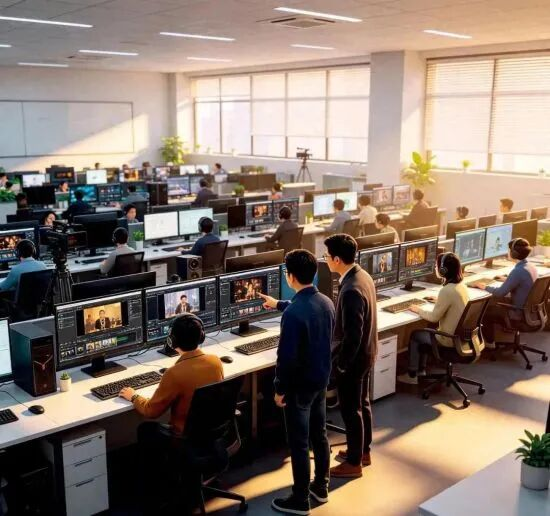
An AI-generated comic production scenario illustration. Photo/China Newsweek
As production became easier, making money did not become easier at the same time.
A Shenzhen-based design company spent around 200,000 yuan to produce 11 AI animated dramas, expecting to earn at least tens of thousands of yuan, but after a month, the revenue was only a few hundred yuan. Another company produced 30 dramas in a month, with only one becoming a hit, just enough to offset the losses of the other 29.
Data from the Spring Festival period is even more telling: the number of real-person dramas released is roughly 1/50 that of AI short dramas, yet their total playback volume is 25 times that of AI dramas. As of the end of February, there were over 120,000 AI dramas and cartoons airing, with fewer than 150 having broken 100 million plays.
The volume and traffic are on entirely different scales.
AI has simply lowered the production threshold for short dramas at an extremely fast speed.
In the past, the ability to produce films was a competitive barrier, but now that anyone can produce content, production capabilities are no longer scarce. The script, aesthetics, IP, channels, investment, and understanding of the audience have become the key factors in determining whether a show can be profitable.
But these are capabilities that can't be built simply by spending a few days learning an AI tool.
AI can enable ordinary individuals to possess the production capabilities that were previously exclusive to professional teams, but the audience still only has 24 hours in a day, and their willingness to pay will not increase in tandem with a sudden multifold increase in content.
Aside from short videos, programming, drawing, and video production have also become more accessible. You can create images without knowing how to draw, generate videos without editing skills, and develop small tools without knowing how to code, all with the help of AI. AI has indeed made many skills more "simple".
But once everyone has mastered the basics, what truly sets players apart comes down to more specialized capabilities—creativity, marketing, and resources.
Images are becoming easier to produce, making aesthetic and demand judgment more crucial; content production is accelerating, with topic selection, channels, and users becoming more important; product development is becoming cheaper, but it's increasingly difficult to determine what's worth doing and who's willing to pay for it.
AI has put tools in the hands of more people, but tool equality and income equality can never be equated.
Ordinary people's opportunities may not lie in "entering the AI industry"
I don't want to reach the conclusion that "AI is a game for the elite, and ordinary people have no opportunity."
According to Zhaopin's data this year, R&D positions still dominate, but non-technical positions such as sales engineers, business development, marketing and branding, and product managers are also emerging as top recruits in the AI industry. The number of AI product manager positions has increased by 87.7% year-over-year.
Apart from recruitment, changes are also taking place within the company.
In previous years, people were most concerned with the model itself, but now more and more companies' needs are changing to be more practical - having already purchased AI, they are now wondering how to actually use it and how to reduce costs and increase efficiency.
No matter how powerful the model is, it's impossible to immediately know which links in a manufacturing enterprise are worth applying AI to, which processes in a retail company are suitable for automation, at which step a sales team needs an agent, and which tasks in finance, customer service, and human resources can be handed over to machines and which must be left to humans.
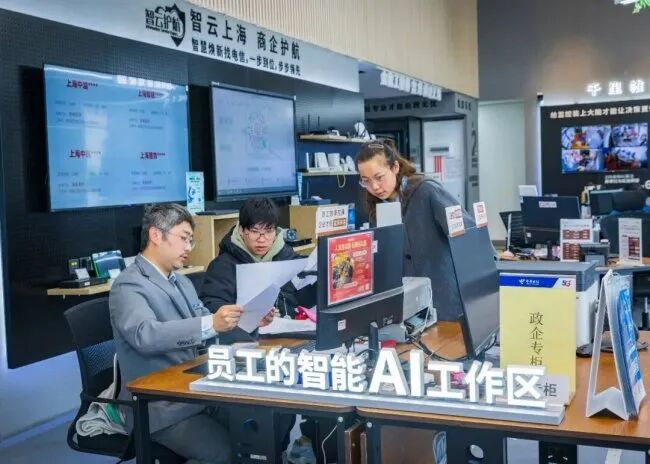
An enterprise's internal intelligent AI workspace. Photo/public reports
Someone who has spent ten years working in supply chains doesn't necessarily need to start from scratch with algorithms; someone who has worked in retail, marketing, or finance also doesn't need to retrain as a programmer. As AI begins to enter these industries, the business experience they have accumulated in the past may become the most lacking thing when it comes to implementing the technology.
The number of such positions is still limited, and career paths and business models have not yet fully stabilized. AI product managers, AI application consultants, FDE, AI Transformation, Agent Builders... there are many names, and the job content is not entirely the same, but they all revolve around one realistic problem:
How to Truly Turn AI into Business Results
If AI continues to penetrate industries such as manufacturing, retail, marketing, finance, real estate, and education, jobs, processes, and divisions of labor will all undergo changes.
In the real estate era, ordinary people didn't need to become developers to share in the industry's benefits; in the internet era, not everyone needs to be a programmer.
If AI is to become an industry cycle that has a widespread impact on ordinary people, it ultimately boils down to work and income. No matter how high the valuations of several model companies are, and even if everyone uses AI tools, this cannot replace that fact.
So far, this shift has not occurred on a large scale.
For ordinary people, let's first look at some very specific issues: how their own jobs have changed due to AI, what kind of AI services their companies are willing to pay for, and whether their years of industry experience can still be sold in the new work model.
These issues may not be as sensational and attention-grabbing as "learning to monetize AI in seven days", but they are the most realistic.
The true sign that AI belongs to ordinary people is probably quite simple:
One doesn't have to be an AI expert to use it to do their original work better, sell it at a higher price, and have more career options.
Sources include: Zhaopin, Chinese Academy of Labor and Social Security, Maimai, Xinhua Daily Telegraph, China Association of Radio and Television, China Newsweek, and other publicly available materials.