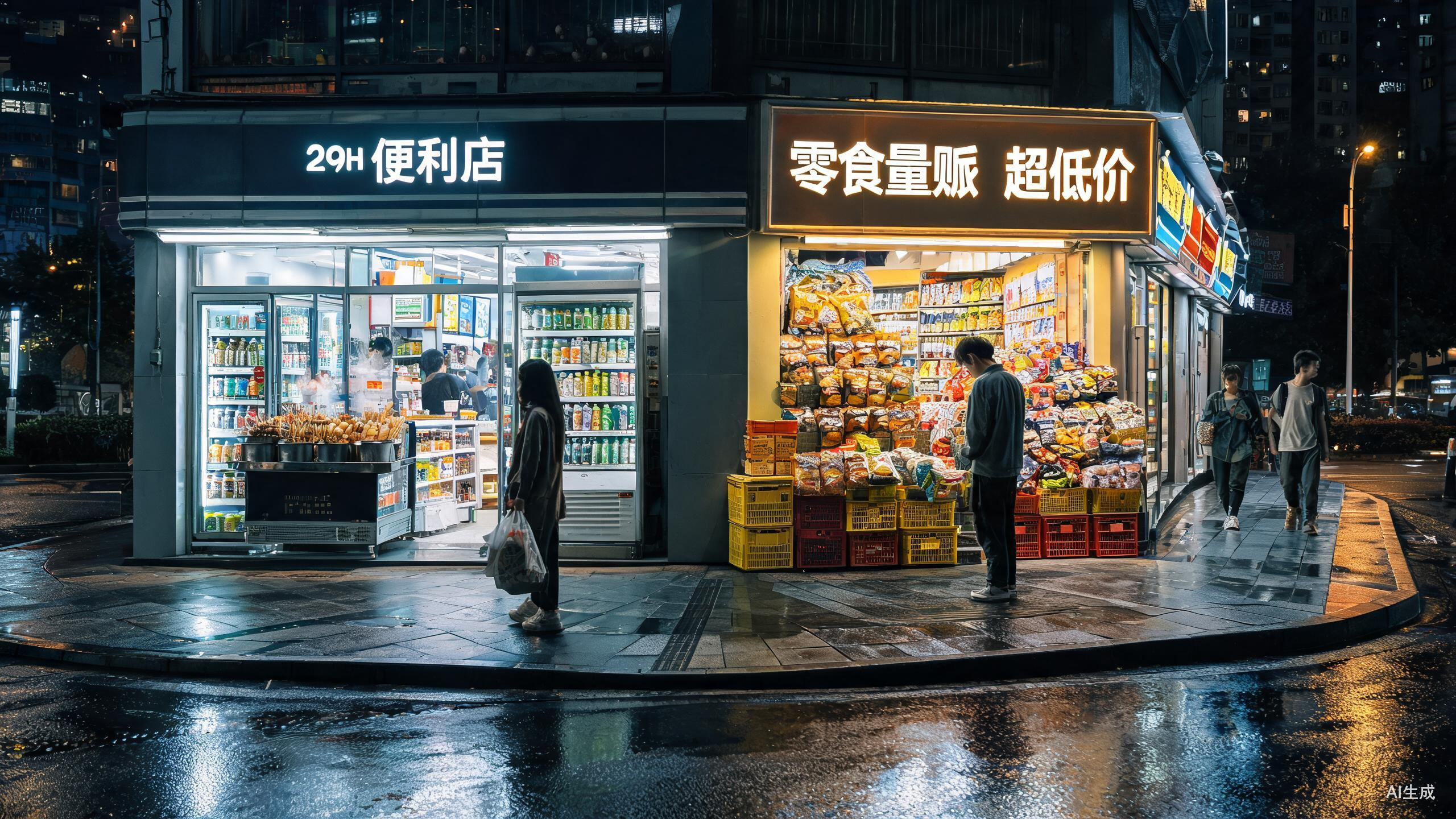
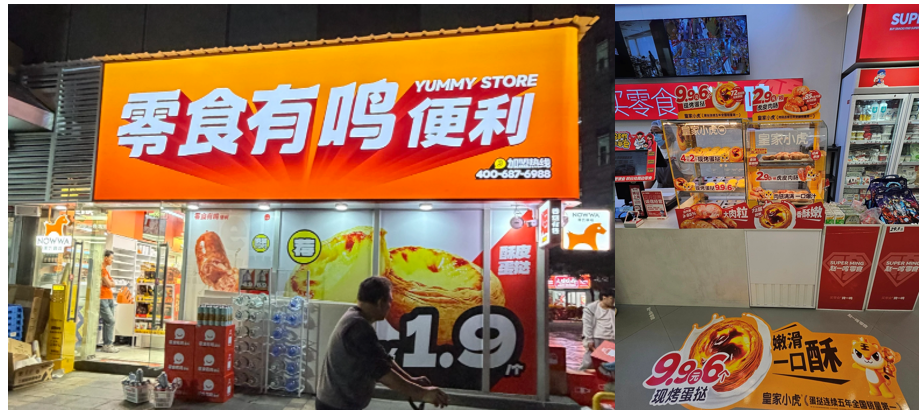
Zhao Yiming's convenience store, "零食有鸣便利店", has opened, and his store has also started selling roasted sausage egg tarts. The prices of beverages are even lower than mine, and only cigarettes and liquor can still sell in decent quantities, making it really hard for my business to compete...
This is the most genuine helplessness we heard from the owners of convenience store franchises in South China during our visit to the market.
Many convenience store owners have noted that nearby snack shops, compared to when they first opened, now have about a third of the characteristics of convenience stores.
Snack Stores Are Becoming Convenience Stores, a Trend That Is Irreversible
The impact of snack stores on convenience stores is undergoing a fundamental transformation.
Zerosnack has entered the convenience store market, with regional snack shops following suit, as store formats, product displays, and even location selection logic are all shifting towards the convenience store model.
"Zero Foods Youming has been opening many convenience stores on our side for nearly three months, and the store location selection requirements are basically all operated according to the logic of convenience stores," a convenience store owner in South China revealed to us.
No longer just a simple snack store, but rather a comprehensive category coverage comparable to convenience stores.
As the product lineup of convenience stores expands from beverages and snacks to short-shelf-life goods, basic hot foods, and even small liquor, it is essentially evolving into a new species.
What's even more alarming is that snack shops have already achieved, or even surpassed, the same level of store density as convenience stores in some areas.
Mengmeng's busy stores have exceeded 30,000 locations, with Haoxianglaimei closely following with 27,000 stores. In terms of scale, if compared separately with convenience store players, it would be second only to Convenience Store First, Meiyijia.
Having more stores means that the convenience of buying things at a snack store is no worse than at a convenience store. "Being able to buy anywhere" is no longer the exclusive advantage of convenience stores.
Moreover, convenience stores can sell the same things at a lower price.
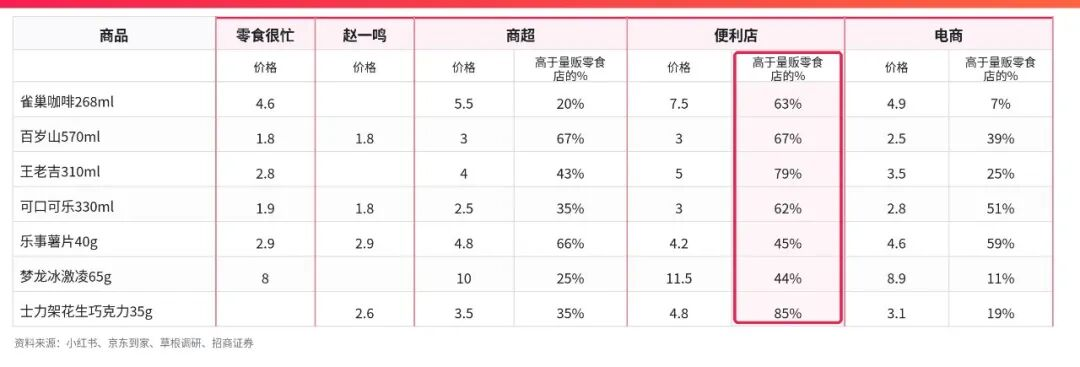
Note: The average transaction value at convenience stores is much higher than at snack shops,
From Merchants Securities' "Convenience Store Chains: Riding the Wind of Cost-Effectiveness, the Time for Explosive Growth is Now"
"Many customers who come to buy cigarettes can be seen carrying bags from snack stores, and in this environment, people are willing to walk a few more steps to save money," said a franchise store owner who has been in the convenience store business for nearly 10 years.
When a business model with a higher store density and prices at least 30% lower than yours starts to do your business, it's only a matter of time before the space for convenience stores is compressed.
However, looking at the bigger picture, there are only 80,000 to 100,000 snack shops in China, compared with 352,000 convenience stores. This significant quantitative difference will inevitably lead snack shops to attempt to transform into convenience stores, thereby finding more development space in the existing market.
Convenience Stores Trapped in Their Own Profit Margin Structure
The high prices of convenience stores are not a new topic, and the reason for these high prices - the gross margin structure - is also not a new topic.
Convenience store outlets typically have gross margins of 30%-40%, and with issues such as payment terms and distributor services, prices are increased by 15-25%. However, snack shops that opt for "flat pricing and fast turnover + direct factory sales" can keep the entire industry chain at 30%-40%.
The difference in profit margin structure stems from the disparity in development eras, a dilemma brought about by the stage of development.
Convenience stores entered China during a period of upward trend in the retail environment, and established a complete pricing system and gross margin distribution model that fit the trend of the upward cycle.
Convenience stores emphasize the "convenience premium" - being close to consumers, operating 24 hours, and providing instant gratification, which allows them to accept a higher price markup.
However, when consumers start to become more price-sensitive, this premium logic is broken.
When snack stores replicate most of the product offerings of convenience stores at lower prices, consumers find that the same items are much cheaper just a few steps away at the snack store, and wonder why they should still go to the convenience store.
Data also confirms this. According to the 2026 China Convenience Store Development Report, convenience store foot traffic and average transaction values have continued to decline, with consumers voting with their feet.
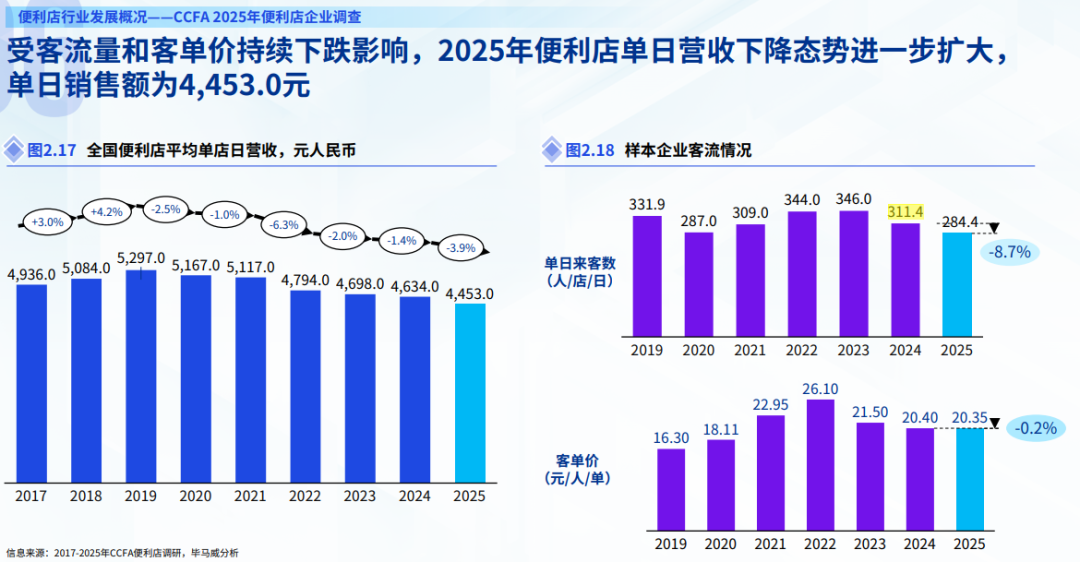
Note: The foot traffic and average transaction value of convenience stores have continued to decline,
According to the "2026 China Convenience Store Development Report" by KPMG
What's even more cruel is that convenience stores are not unaware of their high prices, but rather, they are more likely unsure of what to do about it.
After nearly thirty years of development, a complete and rigid system has taken shape - from site selection, operations, and supply chains to personnel configuration, with all links resulting in "high gross margins and high prices", and a large number of supplier accounts receivable putting pressure on intermediate circulation.
Convenience stores are a product of the economic downturn, designed to adapt to the environment with a "low-margin, low-unit-price, high-turnover" model.
To bring down the gross margin would mean rebuilding the entire system from scratch.
Overhauling the store model, restructuring the product mix, and rebuilding the supply chain, and most crucially, returning the large amounts of funds owed to suppliers - this is a drastic self-amputation.
Most convenience store systems' decision-makers lack both the resolve and the confidence to commit: once gross margins slip, their inventory turnover can't keep pace with snack shops, profits take a direct hit, and the new model risks being undermined.
Convenience stores are thus caught in a dilemma: if they don't change, they will be slowly eroded by snack shops; if they do change, they may die even faster.
Convenience Stores Forced to Adapt to Catering Services, But Face Challenges
Prices have been crushed by snack stores, and convenience has been matched by them, leaving only differentiated competition as an option.
Upon closer inspection, we can see that many convenience stores are moving towards "catering-ization".
The logic isn't complicated. Snack stores can cover standardized retail products, with supply chains that can be streamlined for direct sourcing from manufacturers to achieve rock-bottom prices. But convenience stores hold an advantage snack stores will struggle to replicate in the short term: fresh food and foodservice.
Oden, steamed buns, coffee, bento boxes, rice balls — convenience stores have long sold these products. The task now is to amplify that differentiation capability.
The ability to manage the supply chain and store operations for perishable goods is something that snack stores lack and find difficult to establish quickly.
Convenience stores will naturally choose to focus on the "five meals a day" model.
"Since last year, our store has been experimenting with adding more freshly prepared food, including beef noodles, udon noodles, cart noodles, stuffed pancakes and roasted sweet potatoes," a convenience store franchisee in East China told us.
Convenience stores are no longer just meeting consumers' occasional needs, such as buying a bottle of water when they feel thirsty, but are instead becoming a daily dining solution for consumers, increasing foot traffic and repurchase rates.
This approach is logically sound - by converting consumers from visiting "two or three times a month" to "two or three times a day", the foot traffic and sales of individual stores will naturally increase. Additionally, the high profit margin characteristic of the catering industry can also ensure overall profit margins remain stable even if sales of standard products are diverted.
But in reality, this path has proven to be much more difficult to navigate than imagined.
Firstly, the catering format has exponentially increased the operational requirements for stores. Selling a bottle of water only requires procurement, shelving, and having the consumer pick it up and pay, which incurs almost no operational costs. However, selling a bowl of beef noodles requires dedicated staff, regular restocking, on-site processing, management of shelf life, and handling of near-expiration losses.
Expanding product categories can increase gross margin, but supporting costs rise in tandem, and whether net profit margin can be improved requires careful calculation.
Secondly, the requirement of having five meals a day demands that convenience stores have competitive products available in all five time slots. For breakfast, there are steamed buns and rice balls, for lunch, there are bento and hot meals, for afternoon tea, there are coffee and baked goods, for dinner, there are quick and easy meals, and for late-night snacks, there are guandongzhu and small noodles... each time slot has a different positioning, supply chain, and operational rhythm, all of which pose extremely high requirements for fresh food research and development, supply chain integration, and execution standards.
Most domestic convenience stores do well if they can manage two or three time slots, and it's not easy to really do a good job of covering all five meals a day.
Third, the core barrier to catering format is product power, which is the biggest challenge for all retail enterprises. In the past, fresh food was more about "being available" - whether the boiled fish was delicious or not was not important, what mattered was solving the problem of hunger in the middle of the night.
However, when dining is positioned as a core competitive strategy, consumers will compare convenience store food with professional catering services. Steamed buns can't compete with roadside breakfast shops, bento boxes can't compete with takeout, and coffee can't compete with Ruixing - with so many alternative options, the appeal is greatly diminished.
For convenience stores to truly have competitiveness in catering, they need to continuously invest in research and development of fresh food products, so as not to lose to professional catering stores. This requires the continuous iteration of the research and development team behind them, with large investments and long cycles that not all convenience stores can afford.
So the direction of convenience stores moving into foodservice is correct, but whether it can be executed effectively and build a genuine competitive moat remains a major open question.
The convenience of snack stores is essentially a retail efficiency upgrade that poses a threat to low-efficiency business models.
Diversification into catering is one of the few breakthrough directions for convenience stores, but it requires a transformation from a "convenience retailer" to a "convenience catering service provider".
Whether it can work depends on who can strike a balance between convenience and taste, creating a model that makes consumers willing to come back every day.
As for how many convenience store players will ultimately emerge from this path, we also look forward to finding out.