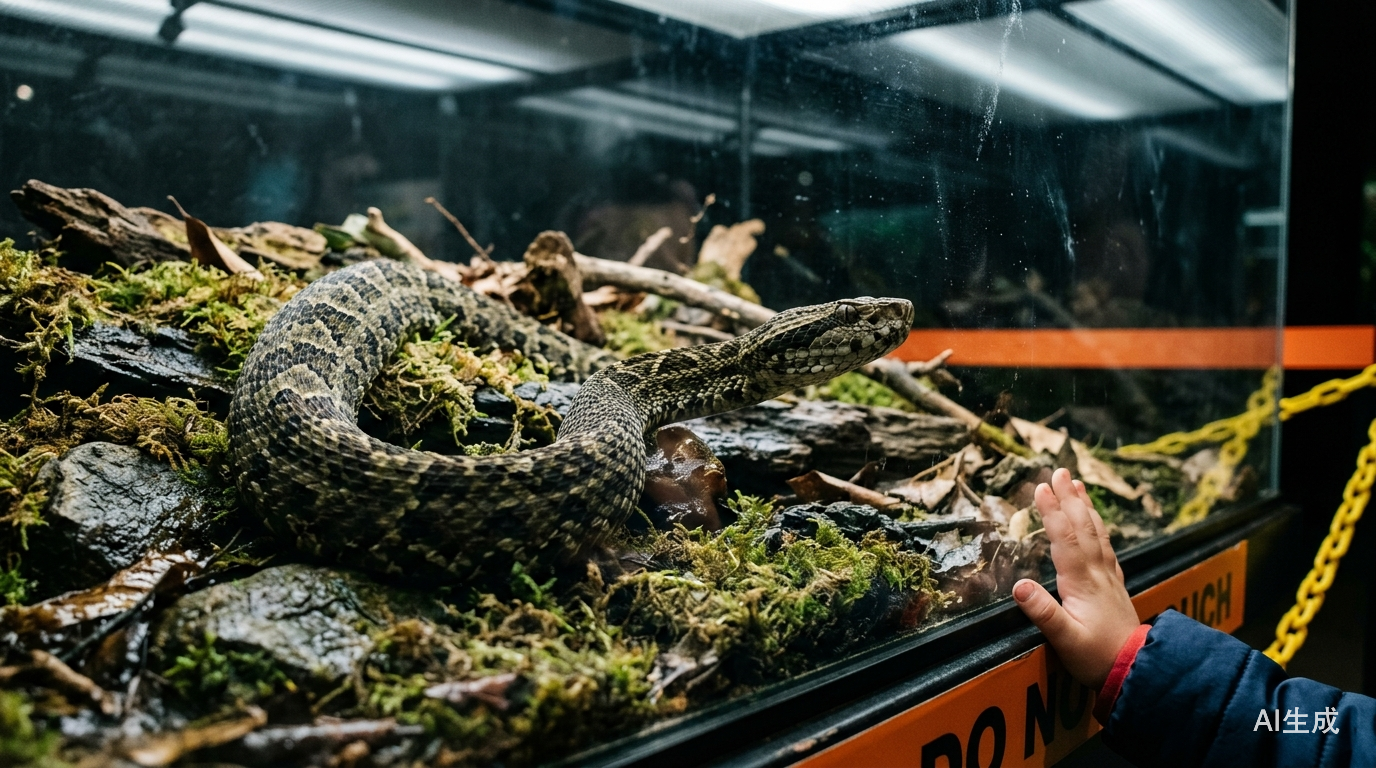
It's not uncommon to see naughty kids, but it's rare to see them being this naughty.
On the evening of August 29, the National Museum of Animals publicly condemned an incident in which two children directly touched snake specimens on display at the museum. The parents, who were accompanying them, not only failed to stop them but also removed the specimens from the display and handed them to the children to play with.
(Photo: @National Zoological Museum) ▼
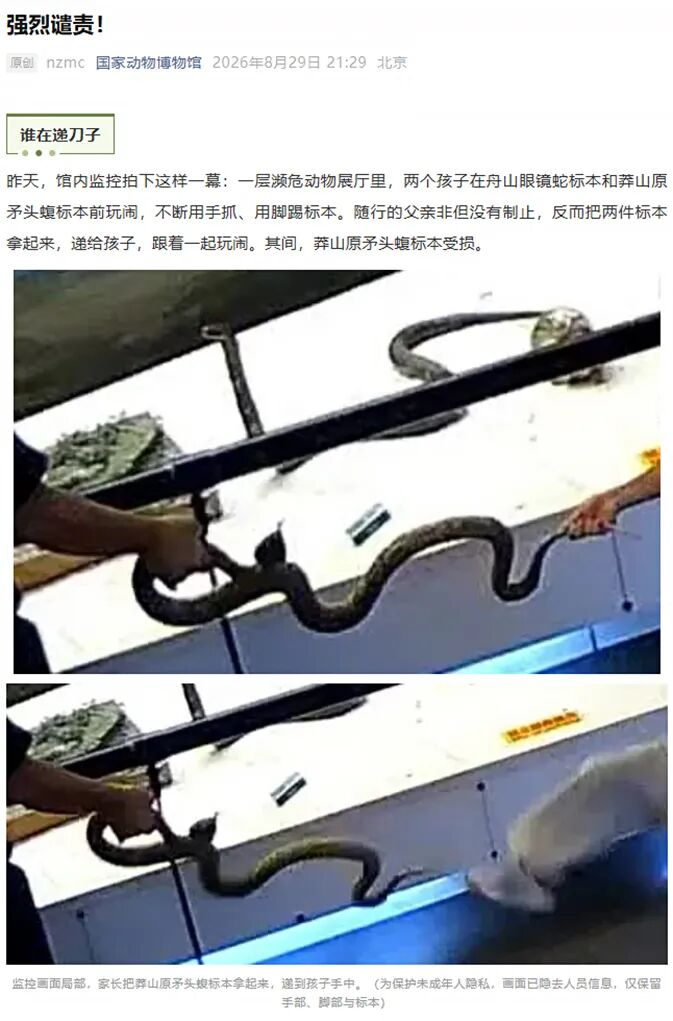
This incident quickly sparked outrage across the internet. Even more ridiculously, after hearing that the specimen had undergone preservation treatment, parents immediately panicked and went to wash their hands... so, weren't they afraid when they first picked it up?
The damaged specimens include a Zhejiang cobra, a nationally protected animal of secondary importance, and an extremely rare Mangshan pit viper, a species of snake endemic to China with a population much smaller than that of the giant panda.
Beware of the snake ahead, beware of slipping
(Image: Tupian Creative & Network) ▼
Behind this specimen lies the dedication of a wildlife conservation worker spanning decades; yet, it has now become a plaything in the hands of unruly children and their parents. The phrase "wasting precious things and destroying valuable resources" is perhaps best illustrated by this scenario.
With only 500 available, it's even rarer than a panda
The Mangshan pit viper is also known by its more famous former name, the Mangshan hot iron head. This species is a nationally protected wild animal and is only found in the tens of square kilometers spanning Hunan's Yizhang County's Mangshan and Guangdong's Nanling protected area.
According to biologists' field survey results, there are only approximately 430-502 in the wild.
In comparison, there are currently 1,900 wild giant pandas nationwide, so calling it the "giant panda of snakes" is a bit of an exaggeration.
It wasn't until the 1980s that people became aware of the existence of this venomous snake. The person who brought two juvenile snakes to experts for identification was Chen Yuanhui, the donor of this damaged specimen, who later became the first person to protect the Mangshan iron-head snake.
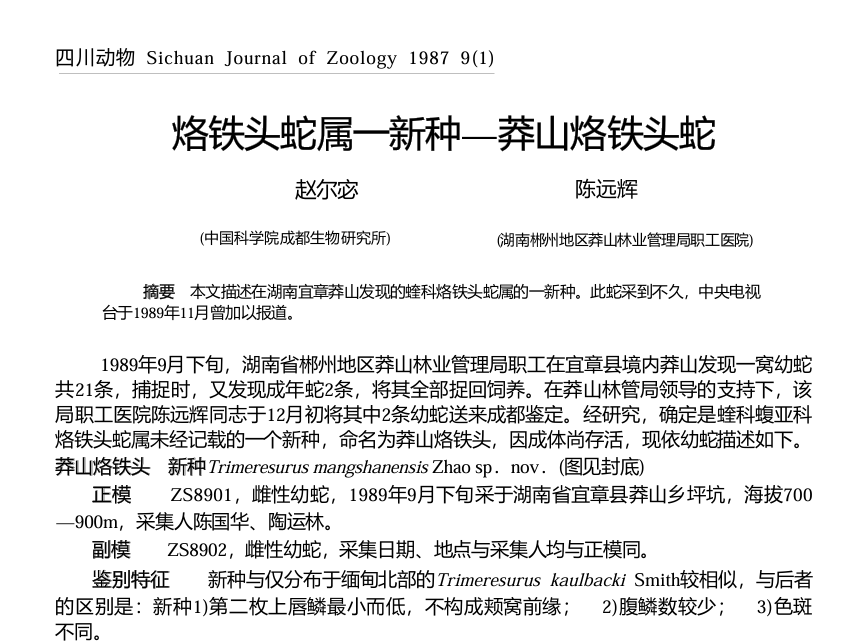
Later, scholars found it to be quite different from other species of pit vipers, and at one point, it was placed in its own genus, Protobothrops mangshanensis. It wasn't until 2009, with the aid of molecular biology, that it was determined to belong to the genus Protobothrops, and its name was changed to its current one.
What's even more troublesome is that the total number of these snakes remains a mystery. As natural masters of disguise, snakes can easily go undetected, even when they're right under your feet, in the sparsely populated southern forests.
Between 1998 and 2000, Chen Yuanhui and a group of domestic scholars made multiple trips into the mountains to conduct investigations, covering a total distance of over 4,000 kilometers, but they only caught sight of the Mangshan iron-head pit viper seven times.
Chen Yuanhui working in the field (Photo: Internet) ▼

To this day, our understanding of this snake remains limited, while the black market has taken notice of it early on:
In the 1990s, the discovery of the Mangshan pit viper caused a national sensation. At the time, a single snake could fetch 25,000 to 50,000 yuan on the black market — this at a time when the term "household with 10,000 yuan in savings" was still very much in use.
Even the snakes used for breeding experiments at local conservation stations in Hunan have been targeted by thieves, with most of the stolen snakes being transported south and eventually ending up as exotic dishes on dinner tables.
Fortunately, the artificial breeding technology for Mangshan pit vipers has matured. In 1994, Chen Yuanhui was the first to successfully artificially incubate Mangshan pit vipers. In recent years, the Mangshan Nature Reserve has successfully incubated more than 200 Mangshan pit vipers and released them back into the wild.
Chen Yuanhui with the Mangshan pit viper (Photo: @The Beijing News)
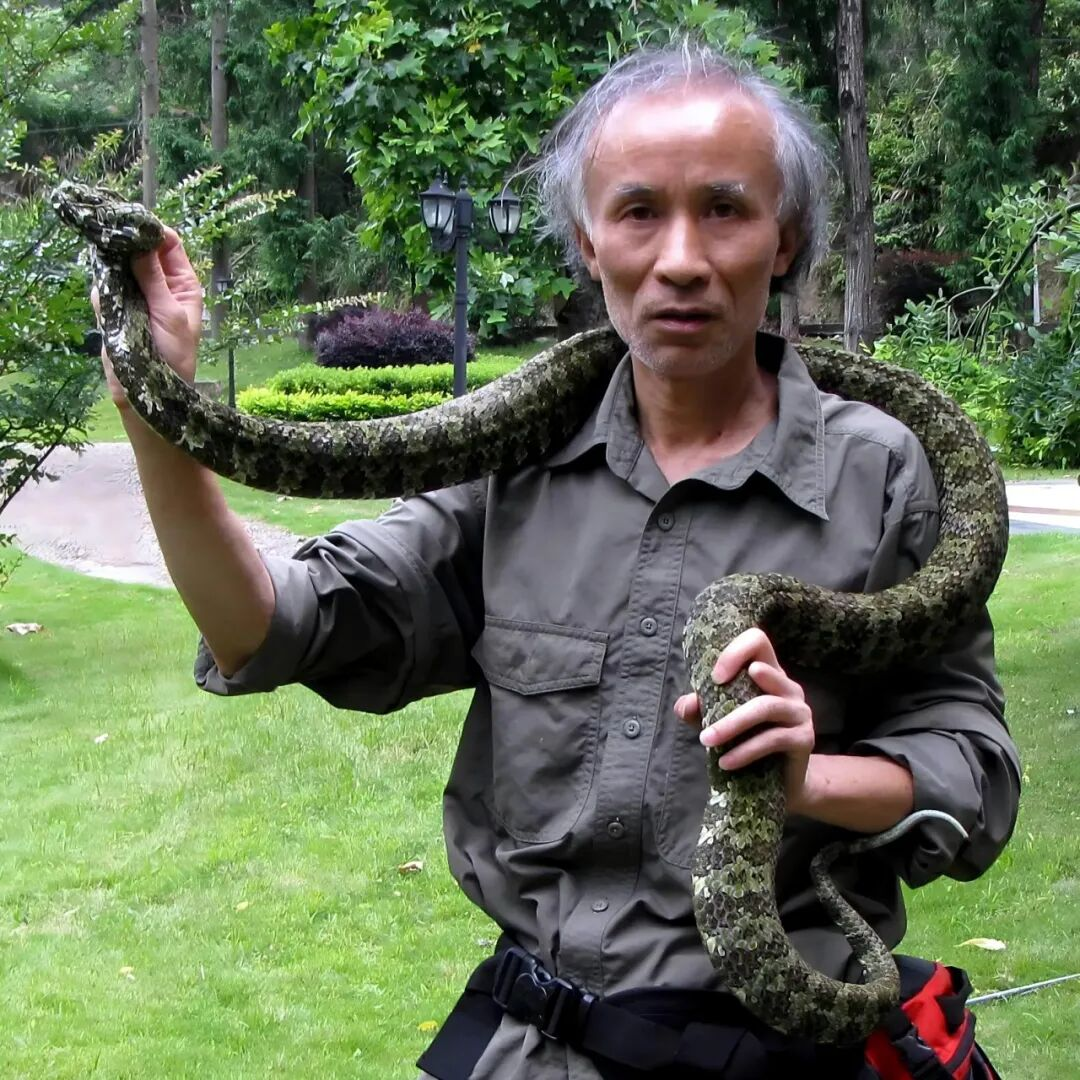
Thus, the actual number of individuals in the wild may be more than the 500 reported in the literature, but the species still remains endangered.
At the Mangshan Forest Park's Iron Head Hall, live exhibits of iron-head snakes can still be seen.
The production of snake specimens involves several steps. First, the snakes are caught and then anesthetized or euthanized. Next, they are skinned and their internal organs are removed. The snakes are then posed in a lifelike position and their skin is treated with chemicals to prevent decay. Finally, the snakes are mounted on a base or in a display case, and any final touches, such as the addition of glass eyes, are added.
According to specimen donor Chen Yuanhui, the specimen damaged by the naughty child was made from a snake that died naturally in 2014, which is in line with the principle of making specimens of endangered species: using naturally deceased individuals as much as possible, as they are extremely rare.
Snake specimens come in a variety of forms, with taxidermied or modeled specimens being more lifelike and able to showcase the snakes' shape and color, making them a popular choice for natural history museums, compared to specimens preserved in formalin or skeletal remains.
Preparing such specimens is also troublesome: the snake skin must be peeled off, soaked in alcohol for a day or two, and then coated with a preservative.
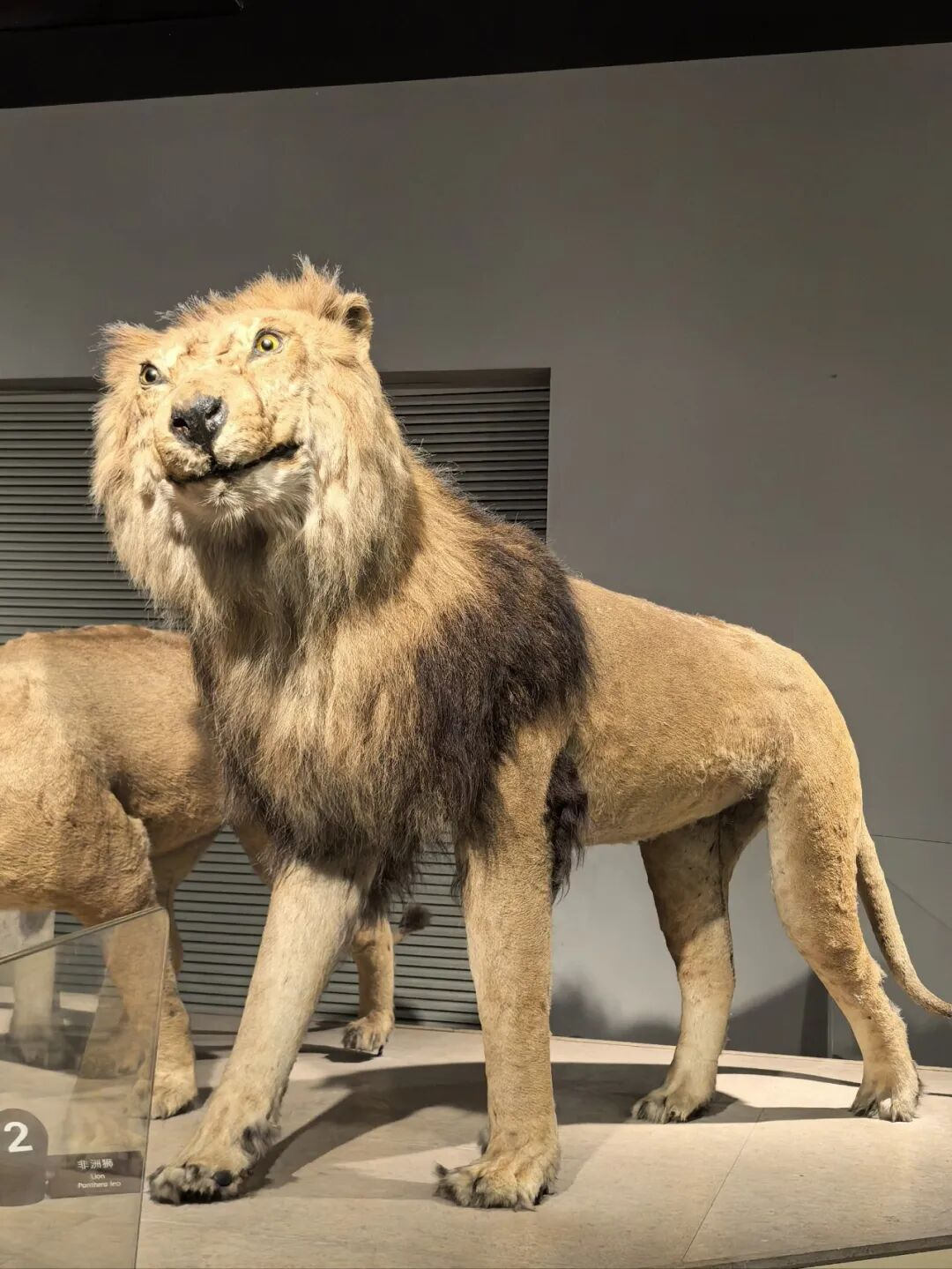
The subsequent filling and shaping are even more challenging for the specimen maker, requiring not only an understanding of the snake's anatomical structure, but also familiarity with its daily habits. Otherwise, the resulting specimen will be somewhat comical - it may resemble a snake, but its posture will be all wrong.
A notable failed specimen case is this lion
(Photos: Internet) ▼
According to media reports, after being discovered by staff at the natural history museum, the parents initially denied any wrongdoing. Upon learning that the specimens might contain residual preservatives, they immediately ran to wash their hands and fled the scene with their child.
After the specimen is made, it needs to be air-dried. Even if there are residual preservatives, the harm is not as great as that caused by those careless hands.
How hard is it to protect an endemic endangered species?
Many extremely small populations of endemic species, such as the Mangshan pitviper, are extremely difficult to protect. With too few individuals and limited habitats, even a slight mishap could lead to the extinction of the entire species.
In Zhejiang's Tianmu Mountain, I once saw a extremely rare wild plant - Tianmu Iron Wood. There are only five wild individuals of the entire species that currently exist.
These five wild Tianmu Ironwood trees are located along the roadside on the way to the Xitianmu Mountain Nature Reserve. Four of them are clustered together, while the fifth stands alone. If you don't know to look for them, it's easy to miss them altogether.
To protect this unique, extremely small population, local authorities installed surveillance cameras for round-the-clock monitoring. Today, the number of artificially cultivated Tianmu ironwood trees has exceeded 3,000, and its endangered status has been somewhat alleviated.
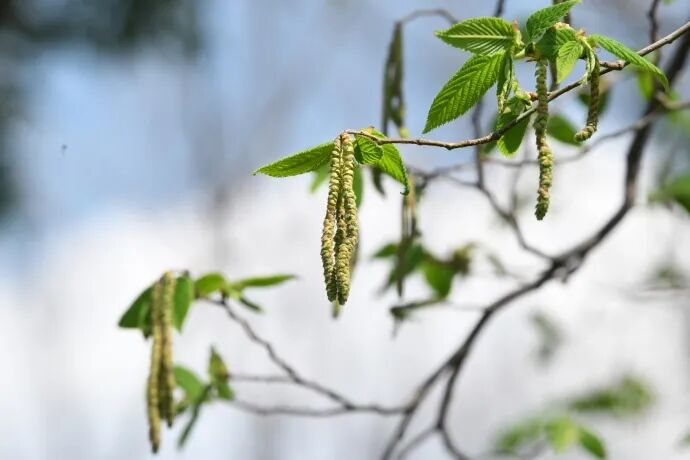
To prevent the occurrence of low-probability events, people have also introduced the Tianmu Iron Wood to botanical gardens in many parts of the country. In 2024, a Tianmu Iron Wood tree that was introduced to the Kunming Botanical Garden in 1990 finally bloomed, and conservation workers were overjoyed, as if they were celebrating the New Year.
The inflorescence of Tianmu Ironwood when it is in bloom (Photo: @Kunming Botanical Garden) ▼
It's already so much trouble to protect stationary plants; if we're talking about snakes that can burrow into the woods and even bite people, the difficulty can only be greater.
Chen Yuanhui, originally a forest doctor, was bitten nine times while participating in the conservation and breeding of the Mangshan iron-headed pit viper, and even had half a finger amputated as a result.
When I was researching and writing this article, I found that most of the papers on the Mangshan iron head were written by Chen Yuanhui, which earned him the nickname "Snake Doctor".
Museum craze?
For a long time, major museums sat nearly empty. In 2018, while interning in Wuhan, I walked up to the Hubei Provincial Museum, filled out a reservation on the spot, and went straight in to see the Marquis Yi of Zeng's bronze bell set and King Goujian of Yue's sword. The galleries were sparse enough that I could stand at the display cases and take my time studying every detail.
These treasures now have long lines in front of them, with each person only able to view them for a short while. The National Museum's "Ancient China" exhibition brings together the best of the country, and just getting in to see the exhibit requires a long wait.
The surge in museum popularity suggests that people are willing to spend more time on cultural activities. However, among those waiting in line, there are always some who just want to find an air-conditioned space to kill time and let their kids run around.
In May this year, I attended a concert at the National Grand Theater's concert hall. As soon as the first piece began, a child in the most expensive pool seat area took off their shoes and socks and stepped on the seat with their bare feet.
The conductor of the concert was 80-year-old Finn Okko Kamu, who won the first Karajan Conducting Competition in 1969. Karajan later invited him to record the complete Sibelius symphonies for the renowned Deutsche Grammophon - the only exception the "conductor king" ever made.
Looking down again, it all seemed utterly ironic.
If you frequently visit museums, theaters, or concert halls, you're probably no stranger to encountering unruly children - although such extreme cases are still rare. In most cases, there's likely an unruly parent behind the unruly child. As the ancients said, "A child not taught is a father's fault."
In 2015, a similar incident occurred at the newly opened Shanghai Natural History Museum, where someone reached through a gap in the glass to touch a model of a Komodo dragon, even breaking off a toe in the process.
It is common sense that exhibits in a museum should not be touched, but it seems that common sense has become the rarest exhibit of all.
If mistakes are made, they must be paid for, otherwise similar incidents will continue to recur. This specimen, which embodies the dedication of Chinese ecological conservation workers over several decades, how can its value be estimated? The specimen may still be repairable, but the decades Chen Yuanguang and others have spent cannot be regained.
Public civility, at times, is this simple: know what not to touch before you reach out.

Chen Sikan. Preliminary Study on Conservation Ecology of the Mangshan Pit Viper [D]. Central South University of Forestry and Technology, 2013.
Chen Yuanhui. The Endangered Status of Elaphe carinata and Conservation Countermeasures[J]. Sichuan Animals, 1998, (2): 76-78.
Chen Yuanhui. Current Status and Existing Problems of Mangshan Iron-head Snake Breeding[J]. Snake Journal, 2010, 22(1): 50-51.
Chen Yuanhui. Investigation on the Mangshan Iron-head Snake Ermia mangshanensis (Zhao, 1990)[J]. Sichuan Journal of Zoology, 2002, (3): 183-184+210.
Huasheng Online: Magical Creatures in Mangshan ② | "Snake Doctor" Chen Yuanhui and the 36 Years with Mangshan Iron-head Snake
Youth Daily: [Verified!] Heartbreaking! The Shanghai Natural History Museum has been open for less than a month, and starfish have been touched to death! The giant lizard's toes have also been broken off by touching!
Methods for Making Serpentine Preserved Specimens, Stuffed Specimens and Skeletal Specimens. Journal of Snakes, 1991, (4): 53-55.
Digital Beijing Science Center: International Museum Day | Unveiling the Secrets! How are those visually stunning and realistic specimens made?
Zhao Ermi, Chen Yuanhui. A new species of the genus Trimeresurus — Trimeresurus mangshanensis[J]. Sichuan Journal of Zoology, 1990, (1): 11-12.
Zhejiang Protection Zone: Magical Creatures in Zhejiang: How Were the Only 5 Remaining Tianmu Ironwood Trees in the World Rescued?