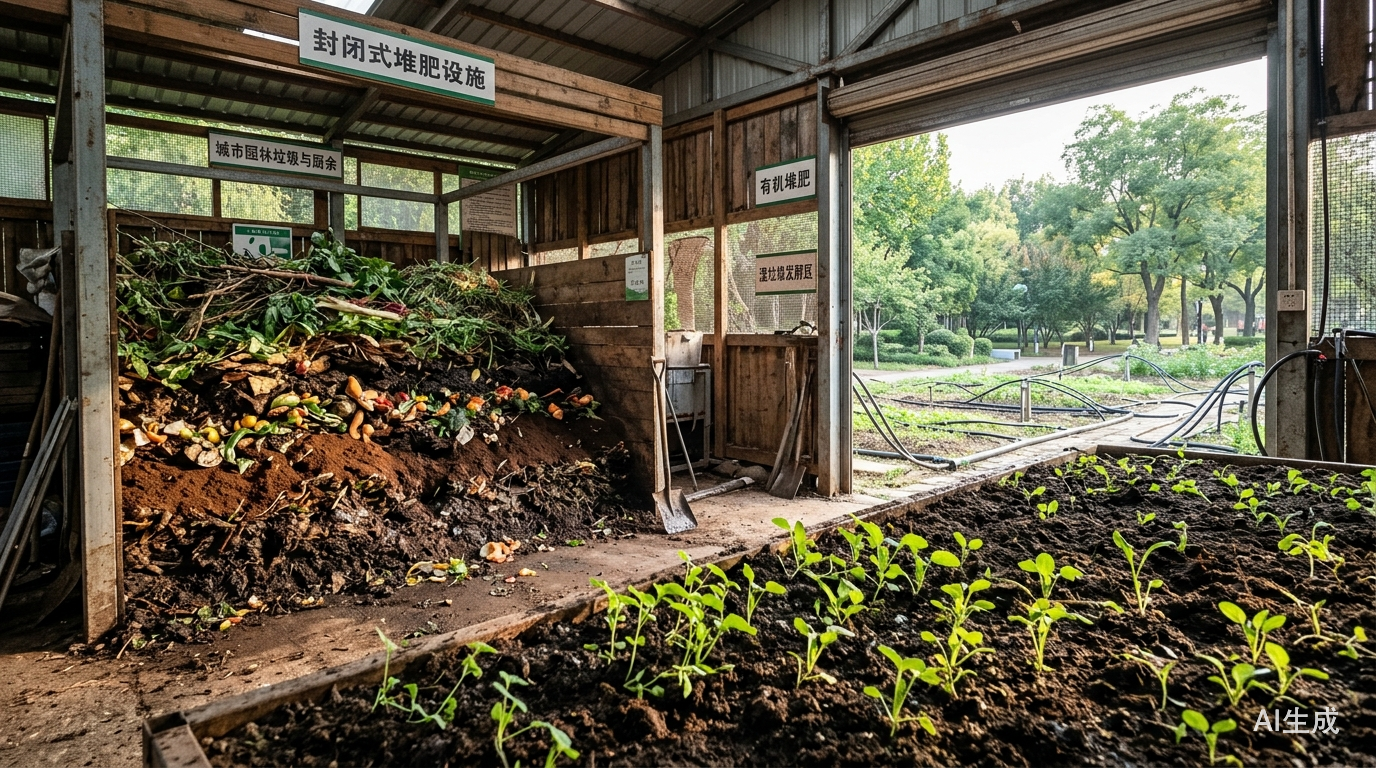
Shanghai's parks, green spaces, roadside trees, residential complexes, and neighborhoods generate around 350,000 tons of green waste annually. Typically viewed as urban garbage that needs to be cleared and disposed of, it also contains organic matter needed for agriculture and urban green spaces.
Similar resources can also be found in kitchens, restaurants, food processing facilities, and even wastewater generated from building operations. Through sorting, detection, and proper treatment, a portion of kitchen waste, coffee grounds, branches and leaves, and domestic sewage can be converted into fertilizers, soil conditioners, and irrigation water.
Cities are not just the end point for consuming agricultural resources, but also continuously produce water, nutrients, and biomass. The real issue is: how to organize these scattered, low-value, and potentially polluted residues into a supply chain that can stably return to agriculture.

Regarding returning to the land, the most intuitive aspect is the food waste in cities.
"Tomorrow's Road" podcast host Jing, who has long been following and reporting on environmental practices, told Fast Company China that in the community composting practices they have come into contact with, "wet materials" with higher water content, such as kitchen waste and fruit peels, are usually mixed with materials like leaves, twigs, and coffee grounds for aerobic composting. After fermentation and maturation, these leftover materials from kitchens and daily consumption can be reused in community gardens, urban green spaces, or returned to farmland.
However, food waste is only part of the city's organic waste. Another larger and more easily overlooked resource comes from urban greening.
Urban roadside trees, parks, and community green spaces undergo multiple pruning and natural shedding every year, continuously generating green waste such as branches, leaves, grass clippings, and flowers. In 2022, when the Ministry of Housing and Urban-Rural Development launched a pilot program for the treatment and resource utilization of urban park green waste, it summarized such materials as being "widely distributed, strongly seasonal, high in transportation costs, highly renewable, and versatile in utilization methods." After classification, crushing, and maturation, different types of green waste can be made into organic mulch, soil improvement substrates, bio-organic fertilizers, and can also be used for biomass fuel and garden path paving.
Their scale is not small. According to data released by the Shanghai Municipal Greening and City Appearance Management Bureau in 2026, the maintenance of parks, green spaces, and roadside trees in Shanghai generates nearly 200,000 tons of green waste per year, while green spaces in units and residential areas generate approximately 150,000 tons per year, totaling around 350,000 tons, and this does not include forest areas. This means that in Shanghai alone, hundreds of thousands of tons of green waste that would otherwise require funding for disposal can be used as valuable raw materials for composting and soil improvement.
Additionally, there are some more unexpected resources in the daily operation of cities.
Jing introduced that on a visit to Weizhou Island, known as the "Road of Tomorrow", the owner of a coffee shop and bed-and-breakfast, A Liang, connected the air conditioner's drainage pipe to a water storage tank, collecting the condensate water generated by the air conditioner and reusing it to irrigate the garden. According to A Liang's estimates, this simple modification can save over 100 tons of water per year. For Weizhou Island, which has limited freshwater resources, the water that was originally discharged through pipes during daily building operations is now part of a local recycling loop.
These seemingly fragmented small-loop practices can also be understood on a larger urban scale.
In 2021, a study published in Circular Economy and Sustainability took Vienna, with a population of approximately 1.92 million, as its subject to calculate the potential for nutrient recovery from domestic wastewater and degradable kitchen waste. The research model showed that if treated through methods such as artificial wetlands and anaerobic digestion, the wastewater and kitchen waste generated by 77,250 residents could theoretically recover enough nitrogen and phosphorus to meet the demand for these two fertilizers for all of Vienna's existing vegetable production. Currently, local vegetable production in Vienna can meet about one-third of the city's vegetable consumption demand.
This does not mean sewage and food waste can be applied directly to farmland. Nutrients in domestic wastewater must first undergo purification, separation, and recovery, while food waste requires sorting and safe treatment before either can become viable agricultural inputs. Yet the calculation highlights a dimension of urban food systems that has long been overlooked: food carries water and nutrients into cities, and after consumption, a substantial share exits the food production system through wastewater and organic waste streams.
Kitchens, parks, roadside trees, and commercial spaces each generate different material flows, and when these paths are combined, a city presents a potential map of agricultural resources.

A type of urban waste having reuse value does not necessarily mean it is naturally a usable agricultural resource.
Before it can be reused, it needs to go through a series of steps including source classification, collection, transportation, sorting, processing, inspection, and utilization. If any one of these steps is missing, potential resources may once again become waste that can only be disposed of.
In cities, where dining, business, communities, and public spaces are highly concentrated, organic waste is constantly generated; gardens, green spaces, urban farms, and park systems that can digest these resources are also relatively concentrated, making short-distance circulation possible.
Distance is particularly crucial for organic waste. Branches and kitchen waste have a large volume, high water content, and limited unit economic value, making transportation distance a direct factor affecting recycling costs. Jing believes that among various zero-waste practices, "local recycling is the most environmentally friendly." Community trimmings are crushed nearby, kitchen waste is composted locally, and the resulting fertilizer is used in surrounding gardens and green spaces, reducing garbage disposal and shortening the distance for resource reuse.
However, density can only be truly translated into an advantage when resources are effectively organized.
According to information released by the Shanghai Municipal Greening and City Appearance Management Bureau in 2026, Shanghai currently has around 90 units of green waste crushing machinery and approximately 95 disposal sites, but most of these sites still primarily rely on temporary stacking, sorting, and crushing. In the central urban area, it is difficult to find stable spaces that can handle branches and leaves while controlling noise and odors; meanwhile, green waste generated by units and residential areas lacks a unified collection channel, with some still being mixed into household garbage or discarded at will.
Costs have further influenced the choice of different treatment paths. The Shanghai Municipal Greening and City Appearance Management Bureau disclosed that the cost of resource-based treatment, such as composting of green waste, is approximately 250 to 300 yuan per ton, while biomass power generation can receive fiscal subsidies. This has led some maintenance companies to prefer transporting green waste to power plants in other provinces and cities, rather than producing organic media or cover materials locally. For individual companies, this is a lower-cost option; from the perspective of urban resource recycling, however, the organic matter is not being returned to the land where it was produced.
Solving this problem requires more than just finding a processing technology; it also means building a connection between the supply side and the end users.
In China, practices such as farmers' markets, community-supported agriculture (CSA), consumer cooperatives, and community stores have established various types of networks between urban consumers and surrounding agriculture. Chang Tianle, the founding editor of Foodaily, a media outlet that has long focused on sustainable food and agriculture, and the organizer of the Beijing Organic Farmers' Market, told Fast Company China that many eco-friendly small farmers are using the municipal sanitation system to collect fallen leaves and medicinal herb residue that would otherwise be unusable, and then composting them. The Beijing Organic Farmers' Market is also promoting household kitchen waste composting to consumers, which is used in community gardens and vegetable plots. Meanwhile, kitchen waste generated by the market's community store is taken back to farms by farmers who come to deliver produce, where it is composted.
Delivery vehicles travel from farms into cities and then bring the cities' organic waste back to the farms, essentially utilizing existing logistics to complete a round trip. This approach eliminates the need to establish a completely independent transportation route and fosters a relatively stable connection between the points of generation and use.
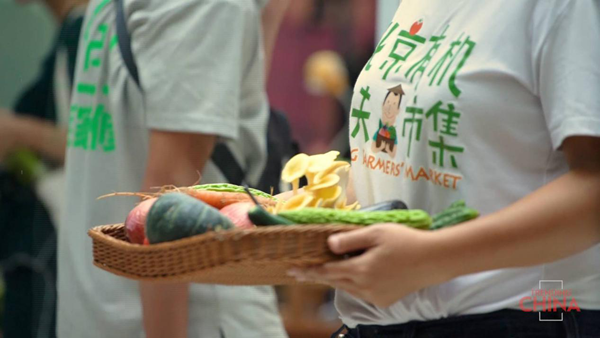
Photo source: Xinhua Net
In 2001, the Food and Agriculture Organization (FAO) of the United Nations launched the Food for the Cities project, focusing on urban food supply in the context of rapid urbanization, as well as the connections between cities and their surrounding rural areas and agriculture. Based on this, the FAO and institutions such as the RUAF Foundation later developed the concept of "urban regional food systems," which encompasses cities and their surrounding suburbs and rural areas into a single food system, examining the entire process from food production, processing, and transportation to consumption and waste.
In this framework, the connection between urban and rural areas is not just about farm products flowing from rural to urban areas, but also about the reverse flow of nutrients and organic resources: surplus food that is safe for consumption should be prioritized for redistribution, while organic waste that is no longer edible can be processed for energy and fertilizer production, serving urban and peri-urban agriculture.
However, most existing urban-rural networks were not established for waste recycling. The urban end requires someone to sort and store, transportation requires extra space, and farms also need to invest in manpower, equipment, and venues to complete subsequent processing. Due to problems such as pollution and mixed loading, not all organic waste is suitable for entry into agriculture.
Chang Tianle observed that without stable financial support and a clear cost-sharing mechanism, these efforts are either difficult to sustain or can only be carried out on a small scale by environmentally conscious individuals and organizations "working for love". The existing network can prove the possibility of return, but it is still not enough to automatically form a large-scale system.
To get these cycles out of their limited, spontaneous practices, it's essential to first clarify that Zero Waste does not mean everything must be recycled.
Jing explained to Fast Company China that zero waste does not literally mean producing no garbage, but rather maximizing the continued use of items that still have value, thereby minimizing the amount that ultimately needs to be incinerated or landfilled. In China, a similar concept, "waste-free cities," is being explored. The Ministry of Ecology and Environment noted that "waste-free" does not mean that no solid waste is generated, but rather that through source reduction and resource utilization, landfilling is minimized to the greatest extent possible.
From this perspective, waste sorting is merely the starting point of such a cycle. To achieve a "waste-free city," it is necessary to track where different residues are generated, in what quantities, who collects them, where they are sent for processing, and who ultimately uses them. Only when these stages are consistently connected can a residue become a stable resource.
The Ministry of Housing and Urban-Rural Development proposed adopting a "decentralized processing + centralized processing" model in the pilot program for garden waste: in parks, green spaces, and nurseries where conditions permit, waste will be crushed and used on site; parts that cannot be disposed of on site will be transported to centralized facilities for processing via specialized vehicles. At the same time, categorized collection, storage, transportation, and processing facilities will be considered part of urban infrastructure, with the entire process managed digitally.
This model seeks to strike a balance between distance and scale. Over-concentration means longer transportation distances, while complete decentralization would result in a lack of equipment, space, and professional management at each processing point. A combination of small-scale collection and pre-processing facilities near the source, and large-scale processing facilities in areas with sufficient space, may be a more realistic approach.
Shanghai is making similar attempts. According to information released by the Shanghai Municipal Greening and City Appearance Management Bureau, Jing'an District built a green waste disposal point in Pengyupu Wedge Green Space in 2025, with a designed annual processing capacity of 2,880 tons. Branches and leaves are crushed and undergo preliminary processing here, with some being dried, sterilized, and made into ground cover particles, while others are sent to external districts to be mixed with wet waste and fermented to produce organic media.
According to calculations cited by the Liberation Daily, if the garden waste in Shanghai's central urban area can be processed locally, transportation costs are expected to decrease by about 50%. To further address the issue of insufficient space in the central urban area, Jing'an District has also connected road greening and maintenance units to a unified management platform, which utilizes vehicle positioning, weighbridge data, and data summaries for scheduling and collection.
By 2026, Shanghai had established around 10 demonstration sites achieving "zero green waste emissions." Century Park completed an on-site processing facility in 2023, essentially eliminating the need to transport green waste out of the park. Shanghai also plans to prioritize the use of mulch and organic growing media derived from locally sourced green waste in land greening, ecological corridor, and park construction projects.
These efforts address the often-overlooked end of the cycle: not only must recyclable products be produced, but they must also be continuously used. If a city processes green waste on one hand, but still procures garden substrates from outside, the cycle will stall at the processing stage. The procurement and usage rules for public greening projects can establish a relatively stable demand for these products.
Practices in Fuzhou, Jiangxi also demonstrate the possibility of forming a closed loop within the public park system. Local reports show that the central urban area of Fuzhou generates around 3,000 tons of garden waste annually, which was previously mostly sent to a municipal waste incineration power plant. The local government then built a facility for processing and utilizing garden waste, turning different types of branches and leaves into ecological covering materials, organic fertilizers, or using them for seedling cultivation, and ultimately reusing them in urban parks and green spaces.
Another cycle occurs between enterprises, institutions and farms.
From March to April 2026, Kadoorie Farm and Botanic Garden in Hong Kong collaborated with 7-Eleven, Heartland Refrigerated Services, and WeGen Farming to provide coffee grounds and their by-products generated by 7CAFÉ, a subsidiary of 7-Eleven, to local farms and gardens for free or at a low cost. The products included screened coffee grounds, compost made from coffee grounds and garden waste, and further processed coffee enzymes.
According to data released by the Kadoorie Farm and Botanic Garden's official account, the first round of the project distributed 2.5 tons of coffee grounds and provided nearly 1 ton of coffee grounds-based agricultural supplies. The second round is planned to continue from September to October 2026. Although the scale is still small compared to the amount of organic waste generated by a city every day, it demonstrates an alternative organizational model: retail stores provide a stable source of raw materials, non-profit organizations connect demand, professional institutions complete processing, and farms serve as the final end-user.
From self-sufficiency within public park systems to the establishment of reverse supply chains between enterprises and farms, various practices are filling in the gaps in urban resource circulation. They also illustrate that a system is not just a treatment plant or a recycling technology, but a comprehensive operational mechanism that covers classification, collection, processing, inspection, utilization, and financial arrangements.
We are familiar with the route food takes to enter cities: starting from farmland, going through processing, transportation, and retail, and finally reaching consumers. For a long time, this route has been almost one-way - agriculture is responsible for production, cities are responsible for consumption, and what is left after consumption goes into the waste management system.
The reuse of urban organic waste is building a return route for this path, but the return route will not be limited to a one-time composting activity or an eco-friendly project of a single store, only when classification, treatment, transportation, and utilization all become stable mechanisms. At that time, the city will not only be the end point of agricultural resources, but also the starting point of the next round of production.