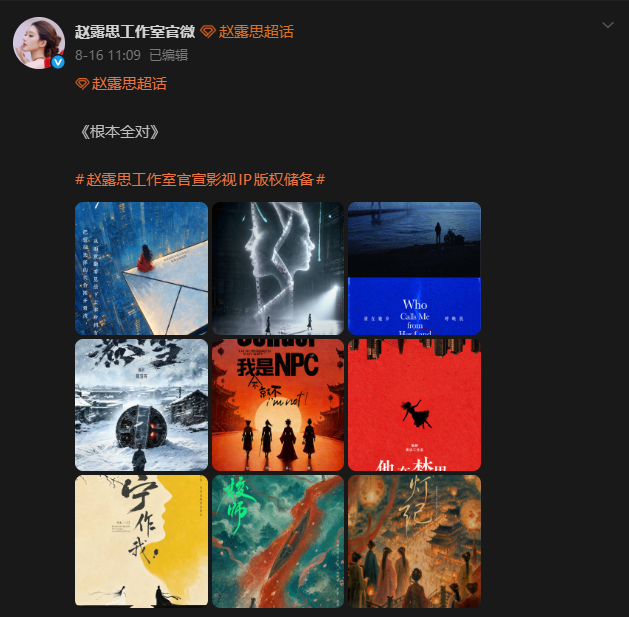
In August, Zhao Lusi, who had not joined a production for more than 550 days, stocked up nine film and television IPs for her team in one go.
A month ago, Zhao Lusi's studio was still soliciting scripts online, but by August, the first batch of projects had been finalized, with the series of short dramas "I'm Not an NPC" starting production in Hengdian. However, Zhao Lusi did not arrange a role for herself, instead taking on the position of producer.
The company develops its own operating system but uses a rival's instead.
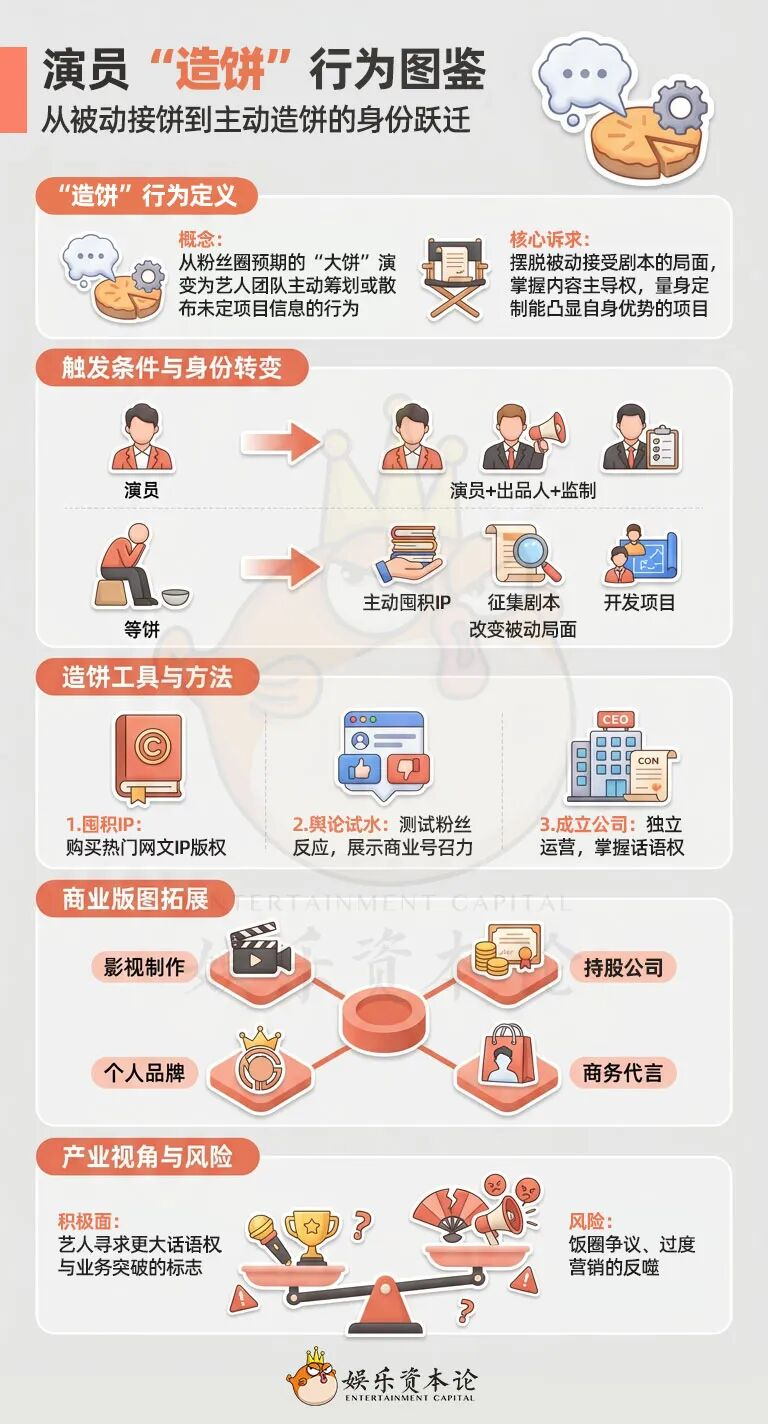
Such instances are becoming more frequent, with Bai Lu starting to purchase IPs and reserve stories she wants to work on, and Qi Wei taking it a step further by licensing her image to AI to create a "digital twin". Zhou Yiwei, an actor in his "uncle circle" age group, is also gradually fading from the screen and picking up the director's baton to direct CCTV's ancient costume dramas. Actors are shifting their focus from competing for the next role to finding stories, accumulating projects, and even developing alternative versions of themselves.
Recently, Yang Tianzhen discussed the film and television industry's downturn with Song Jia on a show, mentioning that the number of drama series that started production this year has reportedly dropped to 30% of last year's level. According to statistics from Xiaoyan, the number of drama crews filming in Hengdian averaged 22.75 per week in the first half of 2026, a year-over-year decrease of 24.84%. The decline was as steep as 43% around the Chinese New Year period. Short dramas once absorbed a large number of actors, but this year, the number of short dramas that started production has also rapidly contracted, and AI content has begun to enter the production chain of real-person films and television shows.
The plays are becoming increasingly difficult to get, and actors have started to shift from waiting for projects to finding their own projects.
Zhao Lusi and Bai Lu are busy "making cakes", while more actors have directly moved to the other side of the film set. Entertainment Capital Theory (id:yuelezibenlun) had a conversation with Jia Jinghui, Hu Dandan, and Ding Nan, three actors who are transitioning to become directors and producers. Interestingly, they did not wait until they had no acting projects before making the switch, and after actually gaining control of their projects, they found that they had the least time to act in their own productions.
This article is based on interviews with three individuals, who are also the 269th to 271st interviewees for "Entertainment Capital Theory" in 2026.
You can tell they're not going to make a movie when you see how long their live streams are getting
The downturn in the film and television industry has not had a significant impact on me, because even when the industry was doing well, I didn't particularly benefit from it, so I don't feel a sense of loss now.
This is what Jia Jinghui said when Xiao Yu asked if the current film and television industry has had an impact on actors, his words being straightforward and persuasive.
However, many actors are indeed doing side jobs, such as live streaming, and even live chatting, and the time spent on live streaming is increasing, so if they're busy filming, where would they find the time? They must be idle.
Most people are unfamiliar with the name Jia Jinghui. To audiences, he is more recognizable as the actor who has played various roles in many popular dramas, such as the hit series "The Legend of Qing Yu" where he portrayed the somewhat silly and annoying Guo Baokun, who often clashed with Fan Xian. It's even harder to associate him with another identity - that of the director of the popular drama "The Lighthouse on the Other Shore", which broke 200 million yuan in box office sales last year.
Of course, most of this work has already moved behind the scenes.
Jia Jinghui is an out-and-out high-energy individual, while the friends and peers around him each have their own circumstances.
Some people say they haven't been on set for eight months, and some haven't worked for over a year. "Of course, there are also friends who are busy traveling, doing yoga, or meditating," Jia Jinghui said. Having seen his fair share, "some actors start to feel anxious after just 10 days at home, they're used to checking their schedules, setting alarms, and living by the rhythm of the production team, and once they don't even have a reference for what time their alarm clock goes off the next day, they feel extremely insecure."
Jia Jinghui has experienced such days, but not now, rather in the past few years when the industry was not as tough as it is today. At that time, he and his wife, also an actor, would only take on one project each per year. As the Spring Festival approached, even giving red envelopes to their parents and children became a big problem. To this day, the couple still has to relive the "year-end hardship" every year to remind themselves.
Embarking on the path of directing Chinese dramas, one reason is that the scale of Chinese dramas is suitable for Jia Jinghui's transformation, and on the other hand, it is indeed true that more good actors are willing to openly embrace Chinese dramas, the former "arrogance" of "being able to film TV dramas and refusing to act in web dramas" has been slowly put aside in an era where even live-action dramas are being replaced by AI-generated ones.
Hu Dandan was among the first wave of actors to reap benefits from short dramas. In 2022, the hit short drama "Nian Nian Wu Ming" directed by Zheng Qingjie made her a household name in the industry, and she loves hearing people say "find Hu Dandan for an actress with good acting skills." This transformation has turned her from a familiar face in historical dramas to an actress who can independently carry the lead role in a Chinese drama. When the market is good, she can film two or three Chinese dramas and two or three long dramas in a year, with her workload already saturated.
But so far in 2026, Hu Dandan has not yet joined the production.
She found it hard to simply attribute the lack of acting opportunities to having no suitable roles. Last year, the Chinese drama "You Yao" she produced was released, which was also a collaboration with Yang Ze, the male lead of "Nian Nian Wu Ming". At that time, she was at a stage where she had a lot of acting work, and in order to advance her own projects, she even turned down some roles that came her way. Gradually, the opportunities to act in other people's productions became fewer and fewer, and perhaps many people assumed that she no longer acted much. This year, she still has several of her own projects in preparation and doesn't have the energy to join others' productions.
So even Hu Dandan herself finds it hard to clarify whether her reduced roles are due to market changes or her own choices.
Some of her fellow actors who were in similar situations a few years ago are "still waiting and struggling, some have switched to doing new media and are doing quite well; others have given up on long and medium-length dramas and switched to shooting short vertical screen dramas." Hu Dandan even thinks that for some people who have made a success of new media, this job is much better than being an actor, "you can decide when to release something, what content to shoot, and business income may also be more substantial. If they didn't still have a strong obsession with acting, they probably wouldn't be willing to come back and continue waiting for roles."
Xiaoyu caught up with Ding Nan as he was still busy wrapping up the Chinese drama "Kong Bian Shuang Xiong" (The Dueling Advocates). Until this year, he was an Enlight Media artist alongside Ding Yuxi and Zhang Ruonan. Now he's a full-fledged producer, and in the first half of the year he also appeared in the costume drama "Feng Wu Jiu Tian" (Phoenix Dance to the Ninth Heaven), starring Gong Jun.
Judging by his resume, he doesn't seem like someone who needs to urgently find a way out. In the past, when he was just an actor, he could film three or four dramas a year and spend about half a year on set; during his three years at Enlight Media, his income was enough to support a normal life. His frustration was that even though he had acting jobs, he found it difficult to take the next step. In the end, he decided to leave the company and go out to find new opportunities.
Ding Nan himself did not suddenly lose his job, but the situation of his friends around him was constantly reminding him of the changes in the industry.
Last year, some friends around him transitioned from traditional long-form dramas to short-form vertical screen dramas, with decent data on Hongguo, earning around 20,000 yuan per day. However, this year, their pay was cut by two-thirds, leaving them with only a few thousand yuan, and they received fewer job offers. "After the New Year, many actors were left idle at home," he said. In Hengdian, he witnessed a decline in long-form dramas and S+ projects, with previously crowded areas becoming desolate, and internet-famous shops in once-lively streets also closing down.
In the past, actors were passive, waiting to see when their next role would come and what character they would play, which was difficult to decide for themselves. Now, with the decline of long dramas and the cooling down of short dramas, and AI starting to enter film and television production, this uncertainty is increasing.
AI-Generated Art from a Capital Perspective in the Entertainment Industry
Rather than waiting to be chosen, Jia Jinghui started directing, while Hu Dandan and Ding Nan turned to producing, opting to take the initiative to switch roles. However, when they actually sat on the other side of the film set, they discovered that with more decision-making power in their hands, their own acting careers were the first to be neglected.
The company makes cakes but doesn't eat them itself?
As a result, the first project produced by Zhao Lusi's team did not star Zhao Lusi herself.
"I absolutely won't act in my own play."
Jia Jingwei clearly told Xiao Yu that during the preparation of Reba's starring role in "Although You Can't Have Everything at the Same Time", there was originally a character in the script that was almost written based on himself, even the name Mark was the same as his English name, but Jia Jingwei still decided to "replace himself".
Hu Dandan suffered this loss before Jia Jingrui.
In the TV series "You Yao" that aired last year, she took on the role of producer for the first time, and in order to attract investors, she decided to play the female lead. It wasn't until filming started that she discovered these two identities were almost naturally in conflict. As an actress, she could sit on set and quietly research her next scene, but as a producer, she was like a "mother" to over 100 people, and any issues that arose, such as actors falling ill, crew members having emotional outbursts, or problems on set, would ultimately be brought to her.
At her busiest, Hu Dandan would shoot for 16 to 18 hours a day, and after wrapping up, she would still have to deal with production issues. On one occasion, when her hair and makeup were only half done, an emergency arose on set, and she rushed out to handle it with her styling incomplete; even when filming romantic scenes between the male and female leads, if she noticed a prop was incorrect out of the corner of her eye, she would instantly break character.
The effort expended by producers is absolutely a hundred times that of actors. After filming 'You Ya', I felt like I had aged ten years.
After this play, Hu Dandan's experience for herself was simple: she could only choose to be either the producer or the female lead in the future.
Ding Nan has taken the producer's seat for the first time this year and quickly abandoned the idea of acting in his own project. His partner, who is currently promoting "Kong Bian Shuang Xiong", asked him if he wanted to play a role, but he ultimately declined. With over 30 days of filming, the schedule of the actors, locations, and budget could change every day, and the special locations for the workplace drama had to be reported a month in advance. Sometimes, he would be rearranging plans for the next day at midnight, leaving him no energy to prepare a role for himself.
As an actor, you only need to serve the character, but as a producer, you serve money.
This statement sounds realistic, yet it is the biggest feeling Ding Nan has after moving behind the scenes. In the past, when he received a script, he would consider why the characters did what they did; now, when he sees the same scene, his first reaction might be how much the scene costs, whether the actors have a schedule conflict, whether the platform can accept it, and whether it can be filmed in the end.
This producer mindset also gives them a completely different perspective on AI compared to when they were just actors. In the popular show "Blind Box", there's a scene where the female lead wins an award at a film festival, but the budget couldn't support a large-scale awards ceremony set. During filming, Jia Jingwei only shot the actress turning around, intentionally leaving the audience seats behind her for post-production. In the end, AI transformed the area behind her into a three-story opera house filled with applauding audiences.
"That image is something we couldn't have achieved, but it only cost 300 yuan, because we got it in just two draws."
Traditional CG can certainly be done, but in Jia Jinghui's view, the biggest difference between the two is price. CG is more stable, while AI is like a lottery, where you might get what you want in two attempts, or you might not get the desired result even after repeated attempts. Directors and producers really need to consider how to balance time costs and expenses, and what kind of stories and shots are worth using AI for.
Jia Jinghui even thinks that after being behind the scenes and looking back, "being an actor is one of the most relaxed jobs in the crew". Previously, actors thought producers were cold and directors were too rushed, but after Hu Dandan became a producer herself, she was sometimes so busy that she was overwhelmed, and when she saw actors sitting there quietly rehearsing their scripts, she couldn't help but feel envious.
So when actors move behind the scenes, it's somewhat contrary to the outside world's imagination of "being in charge and giving oneself a leg up".
They did gain more authority over project decisions, but in exchange, they went from managing a single role to being accountable for dozens or even hundreds of people. In the end, the first thing to get sacrificed is usually their own identity as actors.
When you initiate a project, you may not have the time to participate in it, which is perhaps the first reality actors face when they move to the other side of the camera.
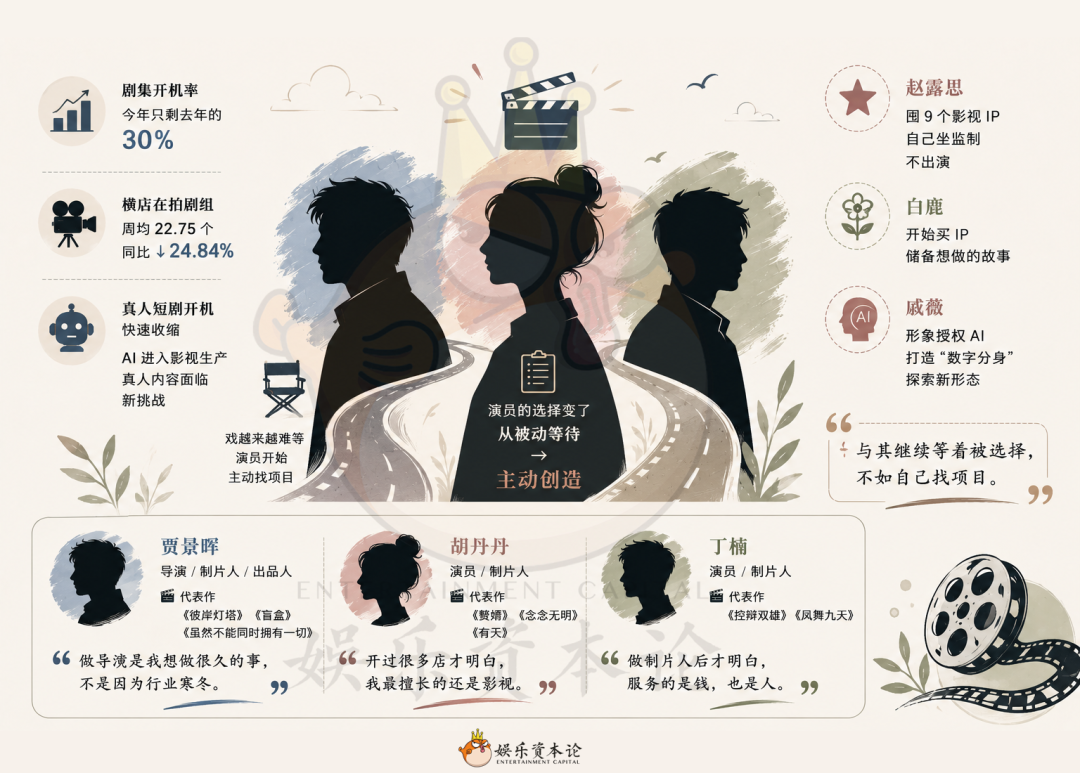
The best "career transition" is not waiting until there are no more films to shoot
They were replaced by AI because there were no more films to shoot, and then they were forced to transition behind the scenes, I think it's even harder for people like that to enter a new profession.
The points or catalysts at which Jia Jinghui, Hu Dandan, and Ding Nan stepped behind the scenes were, for the most part, not due to the "film and television downturn leaving no roles to play".
Jia Jinghui began incubating "Although You Can't Have Everything" four years ago, when the industry was in a much better state, and he was also working as an actor, filming during the day and attending script meetings and making phone calls to advance the project at night. For him, being a director is not a fallback plan, but something he has wanted to do for a long time and has been slowly working towards.
Hu Dandan followed a similar path. In 2021, her drama My Heroic Husband became a breakout hit at the start of the year. In 2022, she rode the short-drama boom with No Surrender. Later, even as her acting schedule remained packed, she began seriously weighing a move into producing.
At first, people advised her to transition into producing, but she resisted. "I didn't want to be a businessperson. I always thought of myself as an artist." It wasn't until she heard a friend say, "A producer isn't just a businessperson—they're also the earliest initiator of a story, the one who decides what content to make and who to bring on board to make it happen." Only then did Hu Dandan suddenly feel that this was something truly interesting.
As for "career transformation", she has also done other businesses outside of acting. She liked flowers, so she opened a flower shop; she liked drinking milk tea, so she opened a milk tea shop. She did whatever she liked, but ultimately ended up failing at it. It wasn't until later that she realized liking something and being truly good at it are not the same thing. What she is most familiar with and has accumulated the most experience in is still film and television.
Jia Jinghui had previously attempted a side business in the true sense of the word. After graduating from the Shanghai Theatre Academy and working as a theater actor, he earned only a few hundred yuan per performance, so he opened a clothing store. However, with the rise of e-commerce, the physical store became unprofitable and was forced to close, prompting him to transition into a career as a film and television actor. After many years of twists and turns, his truly additional second profession is now also that of a director.
Ding Nan's transition was more coincidental. In March or April this year, a director he had previously collaborated with asked him if he wanted to try his hand at production. He didn't have a grand plan for transformation, and at first, he just thought he could give it a try to see if he had more possibilities. Now, he feels that even if he doesn't act in the future, he will likely remain in the film and television industry.
They are not waiting until their acting career is completely stalled before hastily finding their next job.
Hu Dandan is now relieved, because if she had waited until she had no film projects to work on before considering a career change, it might have been too late. Directors and producers also need to relearn, accumulate resources, and wait for projects, and there is no identity that can automatically become a fallback on the second day of an actor's unemployment.
This is also the biggest difference between an actor "proactively choosing a career" and simply finding a side job. Some people are suited to live streaming, some to doing business, and others, after trying their hand at something else, discover that they are still best at working on film sets. Rather than waiting until a job disappears before making a move, it's better to take advantage of the options available and prepare multiple ways to stay in the industry.
As Jia Jinghui put it, "No one knows which cloud will bring rain first, so you might as well prepare several." It's just that those clouds don't necessarily have to be far removed from film and television.
In particular, with AI starting to rewrite film and television production, it's difficult for anyone to predict what the job of an actor will look like in a few years. But at least for Jia Jinghui, Hu Dandan, and Ding Nan, they haven't left the film and television industry, they have just expanded what they can do from one role to an entire project.
Acting remains a profession that waits to be chosen, but at least they now have more than one option.